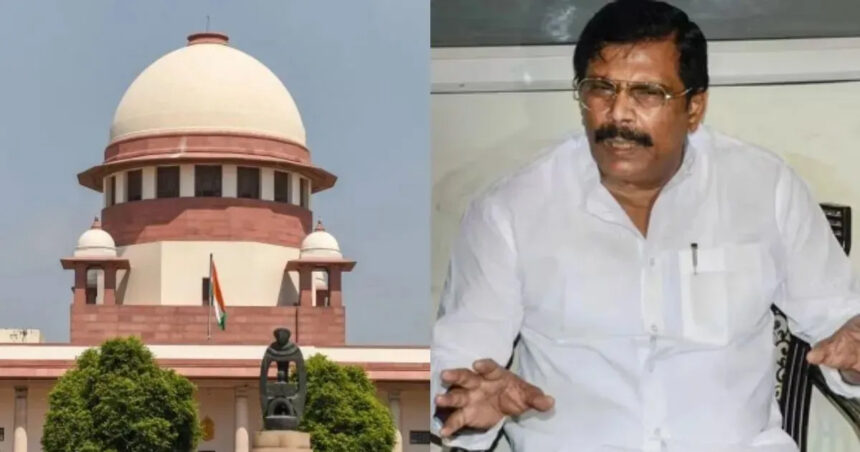
New Delhi | November 27, 2026
Supreme Court cancels early parole of former Bihar member of Parliament, Anand Mohan, who was jailed for life for the 1994 murder of G. Krishnaiah, then District Magistrate of Gopalganj.
Furthermore, the Court ruled that the Bihar Government’s modification on April 10, 2023 to Rule 481(1)(a) of the Bihar Prison Manual 2012, which removed a ban on granting remission to people convicted of murdering a public servant while in office, was unconstitutional.
Anand Mohan was ordered to report himself to the authorities within one month, said a Bench of Dipankar Datta and Sheel Nagu.
On November 26, 2026, the decision was reported widely in the media on the following day.
Background: The 1994 murder of G. Krishnaiah
G. Krishnaiah, an IAS officer and District Magistrate of Gopalganj, was murdered by a crowd in Vaishali district, Bihar on December 5 1994.
Anand Mohan was convicted in relation to this murder. Initially, the Patna High Court sentenced him to death. However, the Supreme Court later converted this to a life sentence.
In 2023 Anand Mohan was paroled after the Bihar Government decided to grant him remission, following the aforementioned modification to Bihar’s prison manual.
The widow of G. Krishnaiah, Uma Krishnaiah, had approached the Supreme Court to question the constitutionality of this modification and also of the order for early parole.
Reasons for the 2023 modification being ruled unconstitutional
Previously, the Bihar Prison Manual included a rule prohibiting remission for those convicted of murdering a public servant while in office.
This was deleted by the Bihar Government’s notification on April 10, 2023. As a result, the State was empowered to grant early parole to Anand Mohan.
The Court noted that this modification constituted ad hoc and abrupt change to the State’s long-standing remission policy (since 2002). The State had not provided sufficient evidence of a reasonable and legitimate objective, nor shown there to have been an honest revision of its reformation policy to warrant such a change.
The Court therefore concluded that the modification had been unduly arbitrary and infringed the guarantee of equality provided for in Article 14 of the Constitution.
It consequently ruled that the notification was unconstitutional, void and non-effective and cancelled the order for early parole dated April 24, 2023.
Reporting in one month
Anand Mohan was told that he should report himself to authorities within one month. Should he not do so, the authorities would be empowered to lawfully ensure his detention.
Whilst emphasising that the State was not indefinitely prohibited from formulating a new remission procedure, the Court added that until Anand Mohan reports himself or is detained, no new procedure can be pursued to modify Rule 481 or review early parole.
Victims’ right to be heard
The Court also addressed the importance of victims and their families in relation to remission.
It ruled that a victim should be allowed to present their views when a remission decision is being made. Therefore, were the State to pursue a new remission procedure, the widow of G. Krishnaiah should be permitted to do so.
Whilst stressing that the view of the victim is not wholly conclusive, the Court noted that the authorities are required to weigh this and then lawfully decide upon relevant issues.
Remission – not automatic
Remission refers to the process whereby a person’s sentence of imprisonment is reduced. Importantly, it does not mean that a person’s conviction is overturned nor does it automatically transform a life sentence into a definite sentence.
Article 72 of the Constitution empowers the President and Article 161, the Governor, similarly. Further, various statutes including Sections 473 and 474 of the Bharatiya Nagarik Suraksha Sanhita, 2023, also outline procedures relating to suspension, remission and commutation of sentences. These will apply in line with the relevant law and during the transition period.
This decision is especially significant as it highlights that although the State has the discretion to formulate a remission policy, it is bound to do so in an even, reasonable and non-discriminatory manner.
Court: Supreme Court of India
Case: Telugu Uma Devi Krishnaiah v. State of Bihar
Proceeding: Writ Petition (Criminal) No. 204 of 2023
Judgment Date: November 26, 2026
Bench: Justice Dipankar Datta and Justice Sheel Nagu
Relevant Provision: Rule 481(1)(a), Bihar Prison Manual, 2012; Article 14 of the Constitution
Outcome: 2023 amendment struck down; premature release quashed; surrender directed within one month
Legal Significance: The judgment reinforces that remission policies must satisfy constitutional standards of non-arbitrariness. It also recognises the right of a victim’s family to be heard in remission proceedings without giving the family an absolute veto over the final decision.

Kshitij Naik
Kshitij Naik is a fourth-year B.A. LL.B. student at MIT-WPU School of Law, Pune, with a strong academic record and multiple published research papers to his name. His writing focuses on arbitration, intellectual property, and corporate law. He believes good legal writing should simplify, not complicate, and brings that approach to every article he writes.