



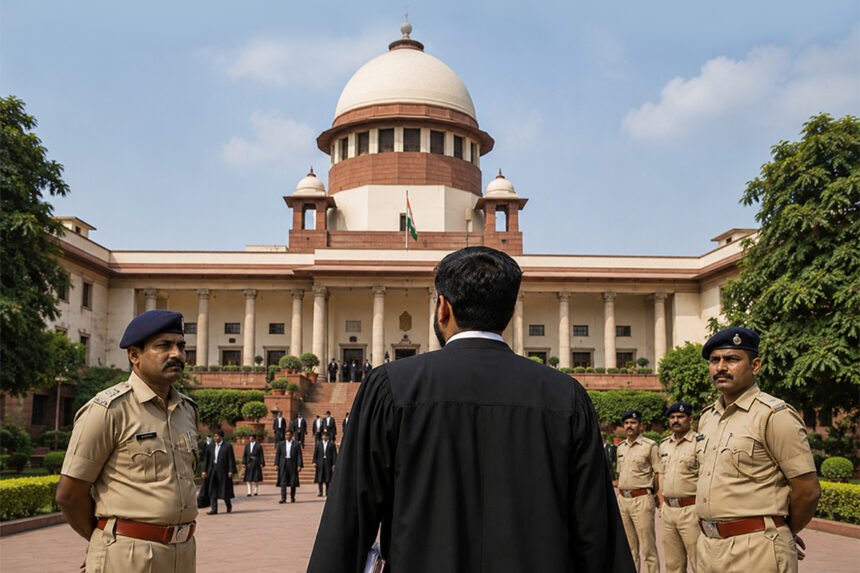
A significant step towards protection, but with the challenge of avoiding misuse, and ensuring advocates still face ordinary criminal law.
The Goa Legislative Assembly has passed the Goa Advocates Protection Bill, 2026, intended to specifically protect advocates from assault, criminal intimidation and harassment in the discharge of their duties. Amongst other things, it provides that a person committing grievous hurt voluntarily is liable to seven years imprisonment and fine of up to ₹1 lakh. It also provides for enhanced punishment for death threats, grievous hurt and destruction of property. It also treats such offences as obstructive of the administration of justice.
What about the other side of the argument? Can the State protect advocates without exposing them to the danger of becoming privileged witnesses and evading ordinary criminal law? The Bill attempts to address this issue too, by providing safeguards against misuse. Let’s take a detailed look at what the new law provides, why it is needed, what it criminalizes, how it proposes to protect advocates and the challenges.
Why a separate law?
The Advocates Protection Bill, 2026, seeks to address the concerns raised by violence, intimidation, harassment, false criminal complaints and threats to property aimed at advocates on account of their professional duties. An advocate can be called upon to appear for a party before tribunals and courts, oppose a writ petition, question government policy, issue notices under court orders or take on a powerful opponent.
The filing of a criminal case against an advocate may cause the victim of an offence to lose access to justice, either directly or indirectly. The Bill draws strength from this argument. In fact, the stronger argument is that it is the right to free legal aid, and the ability of a citizen to approach a court that makes such protection necessary, and not the mere fact that they are an advocate.
What does the Bill criminalize?
The Bill criminalizes assault or use of criminal force . Assault or use of criminal force against an advocate can result in imprisonment for a term of up to two years and fine of ₹55,000. Voluntarily causing grievous hurt Voluntarily causing grievous hurt to an advocate can result in imprisonment for a term of up to seven years and fine of ₹1 lakh. This is the “seven-year jail” referred to in the headline of this story. It is not for assault but for voluntarily causing grievous hurt. That is, the more serious category of hurt. Criminal intimidation and harassment . The Bill also provides for imprisonment for up to two years and fine of ₹25,000 for criminal intimidation or harassment.
Offences such as death threats, voluntarily causing grievous hurt or destruction of property are punishable with imprisonment for a term of up to seven years. This is important, because intimidation does not necessarily involve physical violence. Threats against the advocate or his or her family, and threats to property can also have a debilitating effect on the right to justice.
A key safeguard: complaints against advocates
One of the most important sections of the Bill deals with complaints against advocates. Where a cognizable offence is alleged to have been committed against an advocate for an act done in discharge of his professional duties, such a complaint shall not be investigated by any police officer below the rank of Deputy Superintendent of Police, and the investigation shall conclude within a period of seven days. Furthermore, if a case is filed under this section, it shall be brought to the notice of the Bar Council as well as the concerned advocate association.
The logic behind this is that advocates, in their professional capacity, can be complained against by opponents in litigation or other disputes, who may then seek to take legal action against them, perhaps with the intent to impede their discharge of professional duties. But a preliminary inquiry by senior police officers may prevent such an abuse of the law. The caveat here is that a complaint against an advocate is not necessarily false. The seven-day inquiry needs to be weighed carefully, particularly in a case where a citizen has legitimately suffered injury or prejudice. It is important to keep this in perspective as the difference between professional misconduct and false criminal complaints will often turn on facts peculiar to a given case.
False or malicious complaints
The issue of false or malicious complaints is addressed by the provision which penalizes an advocate who files a false or malicious complaint. Such an advocate can be punished with upto one year imprisonment, fine or both. This is necessary to restore the balance. Police protection for advocates threatened with violence An advocate who is threatened with violence can apply for police protection to a Sessions Court. An officer below the rank of Deputy Superintendent of Police cannot withdraw, reduce or cancel such protection without the permission of the Court which granted it. Criminal law typically acts only after the fact, and this provision allows advocates to seek protection before any violence is committed, and ensures that police protection requests are given due attention.
Compensation and property protection
The law also provides for compensation to advocates. Courts may direct that any fine levied against an offender be paid to the complainant as compensation. The Bill also provides for recovery of damages for loss or destruction of property and reimbursement of expenses, including medical treatment, as may be determined by the court.This is necessary because the harm caused by an offence can extend to the destruction of an advocate’s personal or professional property and exorbitant costs of medical treatment.
The constitutional argument for the Bill
The most compelling argument in favor of the Bill, and the one that gives it legitimacy, is that it will protect not just advocates, but the system of justice itself. An advocate is an officer of the court, and one of the critical elements of the adversarial system of justice. A litigant’s right to access a court is meaningless if the lawyer representing him is unable to perform his duties. A litigant facing a more powerful opponent might find that his right to justice is obstructed if his lawyer is threatened to withdraw from representation on pain of violence. In this respect, the argument for this law is not that advocates deserve more protection, but that the administration of justice itself deserves protection from obstruction.
But the Bill is not without challenges
The first and most obvious criticism is that it seeks to provide excessive protection to advocates. An advocate is a citizen like any other and cannot be placed above the law. The requirement for inquiry by DySP and above will need to be tempered with caution. The other challenge is interpretation of terms such as “in discharge of professional duties”, “harassment”, “misuse” and so on. An advocate assaulted in the course of argument in a court is obviously different from one involved in a dispute outside court in a personal capacity. The former falls squarely within the protection of the law, but the latter does not. The same logic applies to harassment. Harassment in the context of professional duties would presumably include threats and intimidation to withdraw from representation, which directly affects the right to justice. Threats and harassment in a personal context would not fall under this law. To the extent that harassment in personal capacity is subsumed under this law, it needs to be carefully interpreted.
The Goa-specific context
The Advocates Protection Bill comes in the wake of incidents in Goa where advocates were attacked. One such incident involved senior advocate Ankur Kumar, who was alleged to have assaulted in the presence of his 75-year-old client. The alleged assault took place in connection with the demolition of certain structures in Morjim, carried out as per a court order. It is alleged that the attackers attempted to get Advocate Kumar to withdraw the demolition petition, but failed. Lawyers’ associations have expressed concern over such intimidation and sought this law. This incident exemplifies why such a law is needed, because it involves an alleged attempt to obstruct the implementation of a court order by threatening an advocate. If such obstruction goes unpunished, it can undermine the very idea that court orders carry any force or legitimacy. It is not just a matter of rights of an individual advocate being violated, but of whether the rule of law prevails in society.
Legislation can only take one step
The passage of the Advocates Protection Bill cannot be seen as a solution in itself. Even if the law is enacted, it will fail if police do not investigate complaints promptly and thoroughly, or if threats go unprosecuted, and so on. The challenges in implementation are manifold. These include prompt investigation of attacks, threat assessment, preliminary inquiry into complaints, police protection for advocates, protection against false complaints, prosecution for misuse of the law, and so on.
A national issue
The problem of harassment and intimidation as well as complaints against advocates in India is part of a larger national issue. An advocate operates between various stakeholders: people, corporations, government agencies, social groups, politicians and others. There may be no straightforward answer to how this problem can be solved, other than to recognize that a lawyer is a citizen like anyone else, and due process must apply in all cases. The Bill attempts to strike a balance by providing enhanced punishment, police protection, compensation and so on, but also imposing penalties for misuse of the law. Whether this balance holds up in practice will be a matter of interpretation and debate.
Bill, not yet Act
It is also worth noting that the Bill is still merely a Bill. It has been passed by the Legislative Assembly, but has yet to be notified by the government, and come into force. Therefore, it is misleading to refer to it as the Goa Advocates Protection Act, 2026. The correct terminology is the Advocates Protection Bill, 2026 passed by the Legislative Assembly. That may seem like pedantry, and in many ways it is. But that is where lawyers start to learn the importance of precision, especially when dealing with statutes.
Conclusion
The Goa Advocates Protection Bill, 2026, has come a long way. It is not just the seven-year punishment for voluntarily causing grievous hurt that makes it noteworthy. It is the recognition of the fact that violence and threats against advocates can obstruct the administration of justice. But protection can also be misused, and privilege can turn into licence. The advocates must, therefore, have to walk a tightrope between enjoying protection from violence and intimidation, and facing ordinary criminal law for misuse of that protection. That is where the strength of the Bill lies, and where its weakness may also be found. Whether it survives the test of time, and is implemented effectively, will determine whether it is truly a landmark law.