


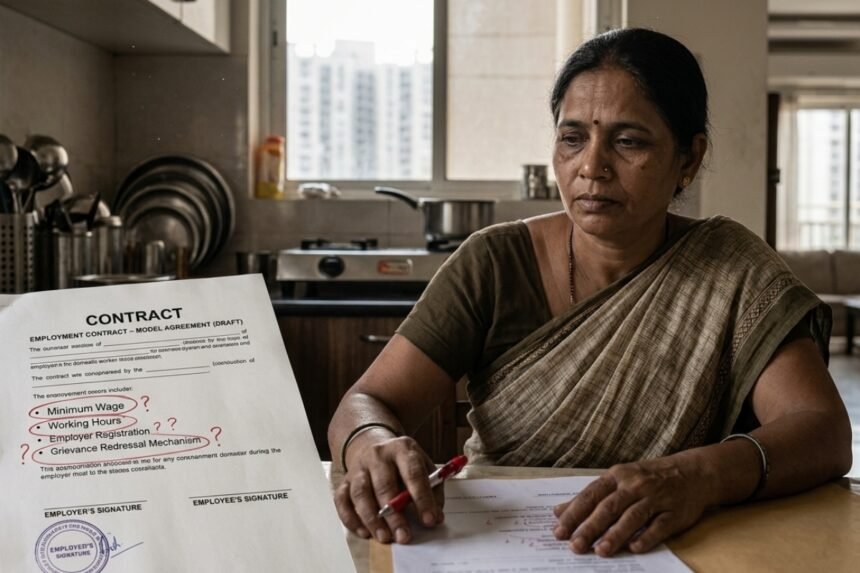
Every home in urban India has a servant, more formally known as help. She is their cook, maid, baby-sitter, and returns to her home at night with nothing to safeguard against exploitation. The law does not consider her a worker. I think that says more about the people who draft this law than those who clean their homes. I propose that it is no coincidence that India’s domestic workers are not protected and regulated as a category. The lawmakers who draft bills on minimum wages and workplace safety and the employers who hire help are from the same social group. No one regulates their own kitchens.
The Old Argument, Refuted
Domestic Workers are not considered as ‘workers’ hence,not entitled for minimum wages, bonus, working hours, leaves, provident fund and various other benefits as provided by the Factories Act and the Shops and Establishments Act which are the labor laws of the states. There are more than 50 million employees in India’s informal sector and almost half of them are women. For decades, the argument has been that a kitchen is not a factory. But a kitchen can be a workplace, as many housewives know. The assumption that domestic workers are not entitled to the same rights as factory workers was convenient but wrong.
What the New Labour Codes Say (And Don’t Say)
This is the part that people aren’t talking about. Labour laws in India have been in flux for the last five years, as the government has been in the process of replacing 29 labour laws with four new laws, called the code on wages, industrial relations code, social security code and the OSH Code (occupational safety and health code). These new laws came into force on 21 November 2025. Government dossiers on these bills state that they cover “all categories of workers including domestic workers”.
In practice that may not be the case, as explained in detail by legal experts. The social security code mentions “unorganised workers” and “wage workers”, including domestic workers, but there is no specific definition as there was for gig workers and platform workers. At the moment there is no clarity for domestic workers on how they fit into the new framework. The most logical solution would have been to follow the model for unorganised workers, where there is a specific government body, the Unorganised Workers’ Provident Fund organisation, which workers can approach directly. But the same does not apply to domestic workers.
The more important issue is that none of the codes provide for a mechanism within the home for enforcement of any law. This means that no inspector could enter a home without the permission of the owner, which few employers would find easy. The social security code mentions the need for a registration system and an appropriate welfare board for processing claims.
While that is a good idea, it puts the onus of claiming rights on the worker, who may not have the time, education or resources to do so. I believe that what the codes fail to do is provide for a basic workers’ compensation scheme for domestic workers. This was recommended by the Unorganised Workers’ Social Security Act, 2008 but was not implemented, and ended up being merely a “notification to be issued by the appropriate government”. I don’t think any of these codes change that much.
Maharashtra Takes Some Steps, But Leaves Much To Be Desired
Maharashtra does deserve credit for having a Domestic Workers’ Welfare Board and for notifying the minimum wages applicable to domestic workers. Other states should follow its lead. However, minimum wages without any teeth are barely a statement of intent. Domestic workers should be able to cite the law and ask for a copy of the order specifying the wages, in the same way as any other employee. Even if they cannot produce proof of wages, hours, a written contract or even claim a helpline, at least the minimum wage order is a law passed by the state that they can quote. The Sexual Harassment of Women at Workplace Act covers domestic workers, but even this one requires an Internal Complaints Committee, which is not going to be set up in any household.
My Prescriptions For Making Domestic Workers Matter
Domestic workers are employed, period. Therefore they must be covered by a single law that treats the home as an extension of the workplace and requires a written contract between employer and employee. They must also have a forum to file a complaint, which may require another law.
India must also accede to ILO convention 189, which it has refused to do since 2011, and which spells out the rights and responsibilities of domestic workers. The government should take a lesson from its social security code and set up a universal compensation scheme for domestic workers. Employers, including those in Pune or Mumbai who think they are well-educated about the law, should read the relevant section once in their lives. There is no law that says domestic workers are not workers. There is a law that barely recognises them as such, and is silent on issues such as harassment or sexual assault. That has happened three decades after the Supreme Court ruling that looked into the Delhi Domestic Working Women’s Forum case. It is time we stopped pretending that domestic workers are not employees.








Kshitij may God blessed you. Very nice article written. Go ahead & keep it up.