

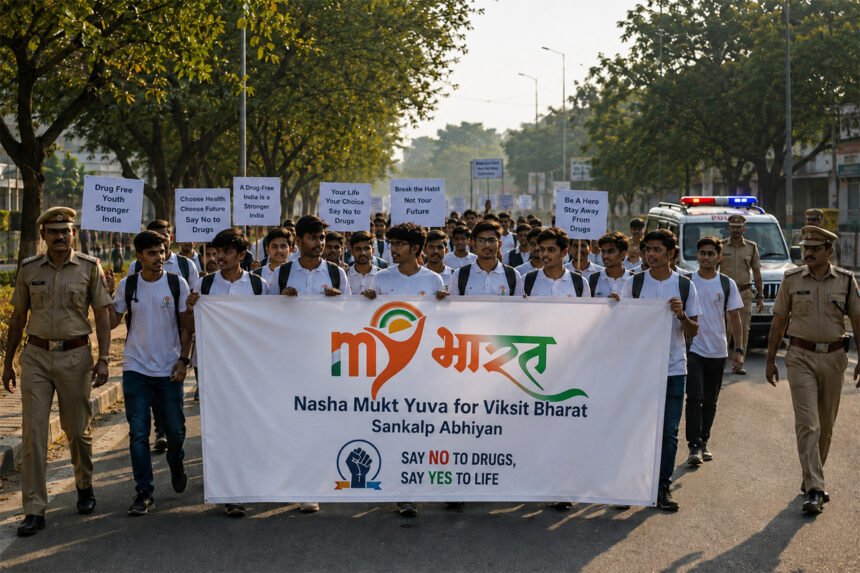
On 2nd August 2026, over one crore young Indians participated in an oath-taking event from more than 28,000 locations across the country. Prime Minister Narendra Modi launched the program called ‘Nasha Mukt Yuva for Viksit Bharat Sankalp Abhiyan’ , a 100 week Jan Bhagidari movement focusing on the key message that every Sunday across the country some area or the other would organize a walkathon, nukkad natak, discussion circle, meditation camp etc. as a pledge to fight against drugs. The movement was the outcome of the pilot project launched last year in Kashi which is now being taken forward on the basis of Kashi Declaration 2025 , a five year roadmap to tackle the menace of substance abuse as a social and health security issue and not just a law and order problem.
The article is a comprehensive document highlighting the menace of drugs as well as the various positive aspects which are the fruit of the efforts of the Central and State governments, civil society, parents, teachers, media and voluntary organisations. It focuses on the law, the case files, the judgments, the ground realities including the illicit trade, international connections, and solutions at various levels from a concerned parent to a police personnel at the check-post.
The Law: How the NDPS Act Grew Teeth
India’s main drug law is the Narcotic Drugs and Psychotropic Substances Act, 1985, the NDPS Act. It was not enacted in response to an exclusively domestic issue: India has fought a near 25-year battle to keep cannabis legal, and lost. When the international community finally forced the Indian government to ban cannabis cultivation, the NDPS Act was the result. It took effect on 14 November 1985, after being passed by the President of India on 16 September. The law prohibits all trade, cultivation, possession, consumption, and transport of narcotic drugs and psychotropic substances with few exceptions, primarily the use of drugs for medical and scientific purposes.
The NDPS Act has been amended four times, in 1988, 2001, 2014, and 2021. All amendments reflected India’s primary concerns about drug trafficking at the time. The 1988 amendment added section 27A making funding illegal trafficking and providing haven for traffickers a punishable offense. The 2001 amendment introduced minimum punishment, distinction between small, moderate, and commercial quantities, and easier bail procedures for addicts. The 2014 amendment introduced punishments for funding awareness campaigns and more severe punishment for commercial trafficking. Finally, the 2021 amendment responded to the Tripura high court’s decision which found a lacuna in section 27A of the NDPS Act. It added synthetic drugs and new psychoactive substances to the list of controlled substances, introduced the death penalty for repeat offenders in some cases, and gave NCB more investigative powers.
Even as the law was amended, the courts continued to find lacunae. For example, in the Tofan Singh v. State of Tamil Nadu case of 2021, the defendant argued that incriminating statements given to NCB detectives cannot be used as evidence, and the court agreed. Additionally, bail as a concept remains contested in drug cases, because section 37 of the NDPS Act requires the court to determine whether the accused person is innocent before considering a bail request. Last week, the Punjab and Haryana High Court stated that drug cartels operating on India’s borders constitute a threat to India’s security, and therefore the bails of the accused should be reviewed under this provision. In effect, the court has begun to consider drug trafficking cases as national security matters.
The Truck on the Highway: What the Cases Actually Show
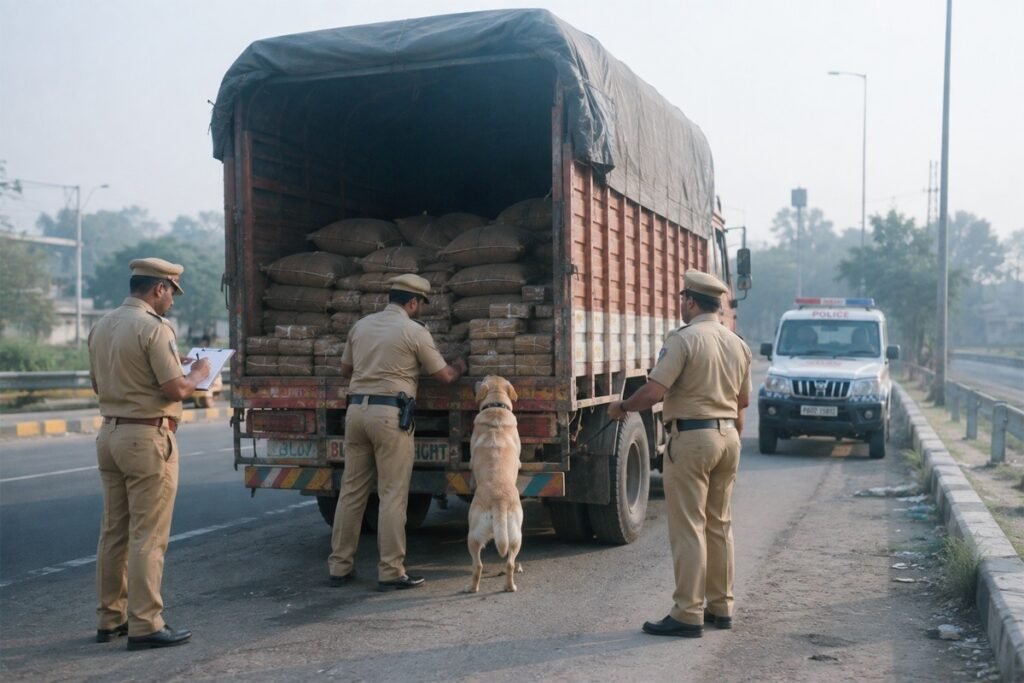
After going through several NDPS judgments, one realises that it is rare to find a lone drug addict being caught red-handed with a joint. Usually, there is always a vehicle, mostly commercial, which either has something hidden in it or has something concealed within it.
In SBS Nagar, Punjab, the police received a tip about a supplier who would be arriving in the district in a truck loaded with heroin from Gujarat. Accordingly, a check-post was laid at the Mahalon bypass, where the truck had to stop. However, as the police chased the vehicle, it tried to flee, but was eventually stopped, leading to the recovery of 38 kg of heroin from the toolbox of the vehicle. Thus, the driver and one more person were arrested as part of the supply chain. This constituted a mid-level drug bust that was routine in Punjab.
Even older judgments show us similar patterns. In Bastar, Chhattisgarh, the police caught a truck carrying onions, from where heroin had been found hidden in the vehicle’s hold. The accused, a driver and a buyer, received the maximum punishment under section 20(b)(ii)(C) of the NDPS Act – twenty years of rigorous imprisonment. In Chandigarh, the NCB caught a truck from Indore that had vegetables on top and 3500 kg of poppy husk at the bottom, sentencing three men from Jalandhar to fifteen years’ rigorous imprisonment. In 2023, five men from Tarn Taran were caught on their way to Kutch, Gujarat, with heroin worth approximately two crore rupees that they intended to sell. The Special Operations Group posing as buyers followed the vehicle, eventually leading to their arrest and a ten-year prison term for each. The judge noted that targeting young people for financial gain was not an unusual phenomenon. On the Indo-Pakistan border, a Fazilka man was given twelve years’ rigorous imprisonment for his role in the recovery of six kg of heroin in a joint operation between NCB and BSF in 2021.
However, there are also more mundane stories that show us the usual modus operandi for drug trafficking in India. Heroin from Pakistan comes through Punjab and is hidden in vegetable-filled trucks or in toolboxes before reaching its destination in Gujarat, Rajasthan, and Delhi via Rajasthan, eventually being sold there. All of these cases began with someone giving police information about strange-looking vehicles, which is why the arrested people are only a minuscule part of the entire network. Moreover, not all such cases end with convictions, as recently discovered by the Gujarat High Court. Upholding an acquittal from thirty years ago, the Court found that despite the commercial quantity of the drug recovered, the prosecution had failed due to lapses in Sections 42, 50, and 57, rendering the entire case invalid under the NDPS Act. Thus, even an undisputed drug trafficker can be set free if his or her defence team manages to prove that the chain of custody was not properly maintained.
The Foreign Hand: Where the Supply Actually Comes From
India’s Position Between the World’s Biggest Drug Production Regions
India is located between two of the world’s largest producer areas of illicit drugs. Roughly between 70 to 80% of all heroin trafficking in India is said to originate from the Golden Crescent, otherwise known as the triangle formed by Afghanistan, Pakistan, and Iran,, a region encompassing Myanmar, Laos, and Thailand. Heroin from the Golden Crescent mainly enters the country through the states of Punjab and Gujarat, whereas the traffic from the Golden Triangle comes in through Myanmar and is associated with insurgencies in the north-east of the country, also known as narco-terrorism because of the funding of terrorism via narcotic sales.
It is worth noting that the maritime route is strategically significant, as shown in September 2021 when the DRI intercepted two cargo boxes at Gujarat’s Mundra port that entered through Bandar Abbas, Iran, and Kandahar, Afghanistan, with talcum stones as the stated cargo. The search found an amount of heroin about 2,988 kilograms, which is worth around 21,000 crore rupees. This is the heroin seizure in the country so far. The National Investigation Agency took over the case because it involved people from countries and money for terrorism. So heroin trafficking is linked to the security of the country.
Drug trafficking is not only about heroin. It also includes amphetamines, which are becoming very popular in some places like Manipur, Nagaland and Mizoram and also in Myanmar, where these drugs come from. The problem of drugs and new substances that affect the mind is getting bigger. In 2021 the Narcotic Drugs and Psychotropic Substances Act 1985 was changed to include these drugs in the list of banned ones. Data from the NCB shows that from 2020 to 2022 there were 59 cases of drug trafficking, on the web and using cryptocurrency. Drug traffickers are also using drones and special underwater technology to watch the borders and coastal waters. They are using these methods to traffic heroin and other drugs.
The Pyramid: Solutions at Every Level
This is the section most reports on drug policy miss out. A multifaceted issue requires interventions at multiple levels from the individual and the family to international diplomacy
Beginning at the lowest layer are the individual and the family. Preventive measures here are the most cost-effective. A mother or father doesn’t need to be a criminal lawyer to realize when their teenager begins to behave erratically that something is wrong. Schools could institute regular drug awareness talks as opposed to ad hoc assemblies that no one cares to listen to. Citizens themselves can constitute eyes and ears on the ground, as most truck interdiction cases began with someone raising an alarm. There is a national helpline, 14446, which provides counseling and connects the caller to the nearest de-addiction center. It is very underutilized, as most people are simply unaware of it. The newly launched Nasha Mukt Bharat Abhiyaan 2.0 mobile app now has a feature that directs users to the nearest treatment facility as well as the helpline and MANAS, a mental health support line.
Moving upward, the next tier consists of the community , resident welfare associations, gyms, and other voluntary social agencies. They are the ones who the Nasha Mukt Yuva campaign attempts to mobilize on Sundays , and they are the most effective persuasive entities, as they provide credible alternatives to youth caught in the clutches of addiction. Community-Based Peer-Led Interventions have been specifically budgeted for in the government’s demand reduction plans since teenagers are far more likely to listen to someone their own age.
The third tier consists of the state consisting of the police, excise departments, and district administration. It is here that the report examines several truck interdiction cases that have made headlines recently. Random checkpoints without prior intelligence are of limited value; every successful operation mentioned in the report began with a specific tip-off about a particular vehicle. At this level, it is crucial to bolster local intelligence apparatuses and improve coordination between state and central agencies. Police training should be enhanced to prevent the kinds of evidentiary mishaps that led to the Gujarat police acquittal. Proper chain of custody procedures must be followed at every stage in the evidence preservation and chain of custody process.
At the national level, coordination and technological capacity-building are the focus. The National Coordination and Response Division (NCORD) has been set up to ensure inter-agency coordination between the Narcotics Control Bureau, DRI, Coast Guard, and state police. This has to be supplemented with enhanced digital and maritime surveillance. At the ports, scanning equipment is required to target cargo traffic. At a higher level, technology is needed to monitor drone usage, which is fast becoming a favored method of trafficking. It is also at this level that the National Action Plan for Drug Demand Reduction, which allocates funds to treatment facilities in government hospitals, is being examined. The most logical allocation decision would be to direct more funds to understaffed and underfunded narcotic treatment facilities in the 372 districts identified as vulnerable to drug abuse. This would mean moving away from an over-concentration on metropolitan centers.
Finally, the top-most layer consists of international coordination. Domestic legislation is ineffective against supply from neighboring countries such as Afghanistan and Myanmar. The report suggests strengthening India’s diplomatic ties with Iran and neighbors via the Mekong-Ganga cooperation framework. In addition, India should share its expertise on combating trafficking with international organizations such as the UNODC and the Financial Action Task Force, and take collective action against money laundering, a critical funding channel for traffickers. India’s own anti-drug laws, including the NDPS Act, Section 27A, and the Prevention of Money Laundering Act, can serve as a model for its neighbors.
What Tying It All Together Actually Looks Like
The Nasha Mukt Yuva for Viksit Bharat Sankalp Abhiyan does exactly what earlier anti-drug rhetoric usually failed to do: it does not present this as some kind of a youth issue that can be solved with a single oath-taking ceremony. Its very design , a hundred weeks, a variety of localised activities, a five-year plan ; all suggest that this is going to be a long-drawn, iterative process that requires buy-in at all levels and multiple layers of society.
However, even as it sets out to tackle drug abuse in all its nefarious forms, it must also recognise that a campaign, however well-intended, can only do so much. It cannot replace the grunt work on the ground ,the police officer who follows due process to ensure that a drug trafficker does not get away simply because of a procedural technicality, the customs personnel at Mundra port who can identify a layer of talc stones cleverly disguised as heroin, the rehabilitative wards with sufficient stretch to accept the call from someone seeking help, the 14446 hotline that is not a black hole that one dials in despair. Law enforcement, rehabilitation, citizen participation , are the signs of any successful anti-narcotic campaign.
India has amended the NDPS Act four times in four decades, each time plugging loopholes that had been exploited. Yet the lacuna that needs plugging is not in the law, however imperfect it may be. It is in the implementation , in the annals of every Punjab highway check-post, in the dockyards of Gujarat, in the bedroom where the adolescent experimentation begins. That is where the rubber meets the road and where citizen vigilance can make all the difference.