



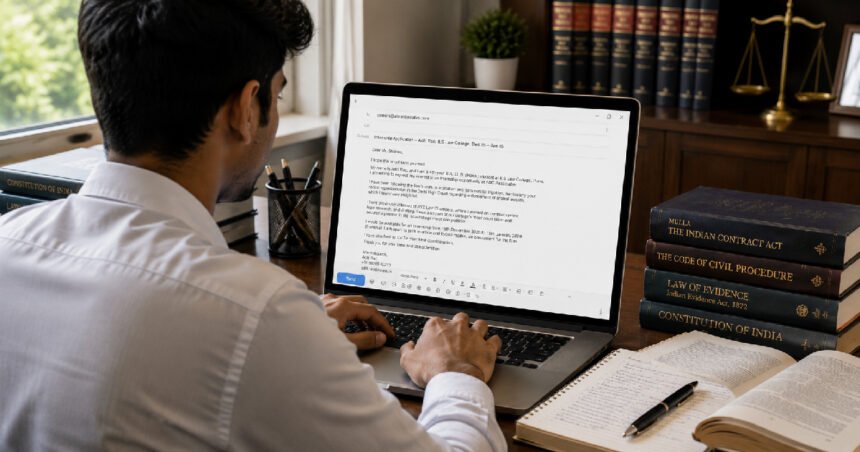
Every law student has sent this kind of email at least once. They find the careers/Contact us section on a law firm’s website. They copy an email from a WhatsApp group, change the name at the top and hit send. Three weeks later they get a reply saying the firm does not hire interns their resume did not make the cut or that cold emailing does not work. Often than not this is true.. The reason the email fails before the recipient even reads the first line is something simple and fixable. A partner or associate at a firm receives dozens of these emails every week during internship seasons. Most are opened, skimmed for four seconds and filed away without a response. The ones that get replies are not sent by the students with the grades. They are sent by people whose first two lines make it clear they are not mass mailing.
Why internship cold emails fail
Before writing the next version of a cold email one must understand why the last one didn’t work. The same problems keep coming up in every email. They can be fixed with minimal effort if the sender knows they exist.
First, the email is addressed to nobody in particular. “Dear Sir/Madam” or “To whom it may concern” is common, but also the easiest to avoid. These are the email forwarded to fifty firms with only the name changed.
Second, the email says nothing about the firm. A line like “I am very interested in your firm’s work” might seem fine in fifty different inboxes.. It should be changed to mention the actual practice areas of the firm and why the sender is genuinely interested in working with them.
Third, the ask is vague or missing. Three paragraphs about achievements might be good for a law school application.. A cold email must clearly state what it wants when it wants it and for how long.
Fourth, attachment is a problem. A resume named “Resume(3) FINAL.pdf” or a file so large it takes ten minutes to load on mobile data is a quick reason to delete the email.
Fifth, the timing is off. Emailing during the litigation months or just one day before an internship starts is a fast way to get no response ,no matter how well the rest of the email is written. These are issues.They can be fixed with little effort if the sender knows there are problems.
Forethought before writing that E -mail
● The best cold emails are not written after hours of research.. They are put together with minimal effort only after knowing three things. The sender must know what the firm does, who to write to and what the internship season looks like at that firm.
● Knowing what the firm does matters a lot. A firm that focuses on arbitration will expect an email from someone interested in litigation. In cases five minutes on the firm’s website or reading a recent case they handled is enough.
● Knowing who to write to is also important. Emails sent to an inbox often go unanswered.. Emails sent to a specific associate have a better chance. Finding the person involves checking the firm’s website browsing LinkedIn and asking seniors for contacts.
● Knowing what the internship season looks like is the thing. Litigation internships for example are usually announced months in advance. Writing four days before an internship starts rarely works. Writing six to eight weeks ahead and offering flexibility with dates if needed works better.
The subject line decides whether an email will be opened or not
Before the recipient reads the body of the email they see the line. Most subject lines are written in a way that makes people not want to open the email.
An email titled “Internship application” or “Regarding internship” tells the recipient nothing. It is unlikely to get opened unless the person’s already curious.
A good subject line tells the recipient everything they need to know. It gets them interested. A subject like “Internship application, Aditi Rao, ILS Law College from Dec 15 to Jan 15” gives all key details in one line. The recipient can decide if they want to read as soon as they see it.
If a senior or professor recommended the sender putting that in the line like “Internship application, referred by Dr. Mehta”greatly increases the chance the email will be opened and read.
The structure of a working email
A cold email should be short enough to read on a phone in under half a minute. It follows the basic structure as a formal letter.
The greeting is simple. Use a name if known. Otherwise “Dear Mr. Sharma”. Dear Adv. Kulkarni” works.
The opening line should say who the sender is and why they are writing away. No beating around the bush.
The next line should say something about the firm. This is often the important part. It shows the sender actually knew who they were writing to. It could be something the firm did recently the practice areas they specialize in or the exact reason the sender applied.
The next part explains why the sender should be hired. It is usually no than two or three lines. Most academic background details go in the CV, which should be attached. A brief mention of experiences like a moot court, research paper or prior internships is enough.
Then comes the ask. For internships this should be no more than one or two sentences. State the time period. Ask precisely what is being applied for. Vague asks get responses or no response at all.
Finally a short closing. Thank the recipient for their time. Mention the CV is attached. Sign off with the sender’s name and contact details.
Here’s an example of an email that follows this structure.
Subject: Internship application : Aditi Rao, Dec 15 to Jan 15
Dear Adv. Deshmukh
My name is Aditi Rao. I am a fourth year law student at XYZ Law College, Pune. I am writing to you to request an internship opportunity with your chambers for a period of four weeks from the 15th of December to the 15th of January.
I have been following your work in commercial arbitration including the matter your chambers were recently handling before the Bombay High Court regarding the enforceability of emergency arbitrator awards and I would be glad for the opportunity to observe and assist with similar work during my internship.
Over the years I have been doing a research internship with an arbitration focused chamber based out of Pune and have co-authored a short paper on interim measures under Section 9 of the Arbitration and Conciliation Act, which I have attached along with my CV for your perusal. I am comfortable with research and drafting and can assist with case law compilations and am available to work full time for the entire duration mentioned above and some flexibility on the start date if required.
I have attached my CV. Writing sample for your review. Thank you for your time and consideration. I look forward to hearing from you.
Regards, Aditi Rao Fourth Year XYZ Law College, Pune [Phone number] [Email address]
Notice how the ask is at the beginning not buried in the middle. It mentions a thing the firm has done, not generic praise. It keeps the background to two relevant lines. It closes briefly without fluff.
Mistakes worth checking before hitting the send key
Some mistakes are worth checking twice before sending a cold email
● Sending the wrong firm’s name because you reused an old template and forgot to change it. This happens more often than anyone likes to admit and is an instant, unrecoverable mistake.
● Attaching the wrong file, an old CV, an unrelated document, or nothing at all despite writing “please find attached” in the email.
● Writing an email so long that the actual ask gets lost somewhere in the third paragraph. If a reader has to search for what you actually want, most will not bother.
● Following up too soon, or not following up at all. A polite follow up after seven to ten working days, briefly restating your interest and availability, is normal and expected. Following up after two days looks impatient, and never following up at all wastes an opportunity that a single reminder might have converted.
● Sending during odd hours or in a way that makes the email look automated, several near identical emails sent within a minute of each other to different firms, all visible in a badly managed CC field, is a mistake that is entirely avoidable with basic care.
All of these are avoidable. They can save the sender a lot of trouble later.
What to do after hitting the send key
A cold email is not a lottery ticket that you buy once and then forget about. Law firms that don’t reply within twenty days are not always uninterested. Sometimes they just need a polite follow-up to respond. Keeping track of which firms you’ve contacted when you reached out and how long it’s been since you sent the message is essential. This helps you manage follow-ups and stay organized. You can keep this record in an Excel sheet, a notepad on your phone or any other method that works for you.. The key is to keep track of your outreach. Internship seasons last months. The law students who get the replies are the ones who treat cold emailing, like any other legal writing. They write clearly they are specific they address people, not faceless organizations and they don’t treat it as a formality to get out of the way before the real work of interning begins.