


Justice Doesn't Begin in Court. It Begins with Awareness
By Adv. Vishal Kale
Advocate, Arbitrator & Chief Mentor, My Legal Employer News LLP
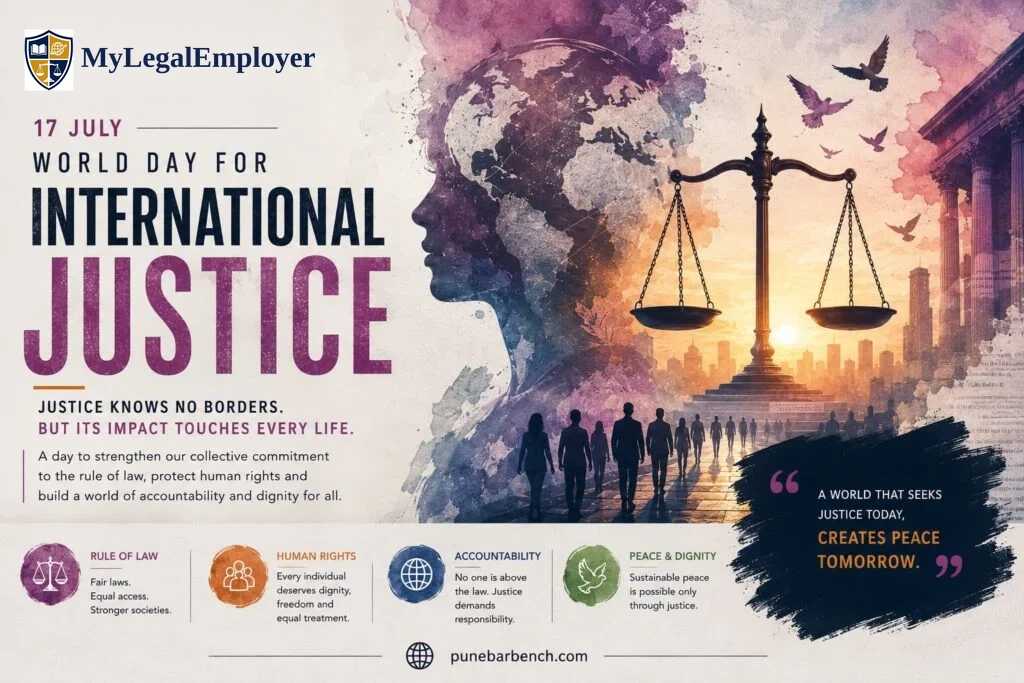
Every year, 17 July, the world observes International Justice Day. The conversation often revolves around international tribunals, landmark judgments, and global accountability.
But justice isn’t born in international courts.
It begins much earlier, when an ordinary citizen knows that they have rights, understands when those rights are violated, and has the confidence to stand up for them.
That is where every strong democracy truly begins.
For over two decades in the legal profession, I have seen one reality repeat itself: people often lose not because the law failed them, but because they never knew the law was standing beside them.
Legal awareness remains one of the greatest gaps in our justice system.
Our Constitution guarantees equality, liberty, dignity, and protection. Our legal framework offers remedies for consumers, safeguards against cybercrime, protections for women and senior citizens, access to legal aid, and numerous mechanisms designed to uphold justice.
Yet countless people continue to suffer in silence—not because these rights don’t exist, but because they don’t know they do.
And ignorance of rights often becomes the greatest advantage for those who choose to exploit others.
Justice, therefore, cannot be measured only by the number of cases decided or courts established. Its true strength lies in how accessible the law is to the people it exists to protect.
This places an important responsibility on the legal fraternity.
A lawyer’s role extends far beyond arguments in a courtroom. We are interpreters of the law, educators within society, and custodians of public trust. Every conversation that simplifies a legal concept, every awareness session, every article that makes the law easier to understand, these are equally meaningful contributions to justice.
The profession is not merely about winning cases.
It is about building confidence in the rule of law.
Today, information travels faster than ever. Social media, digital platforms, and online forums have made legal content readily available. But accessibility is not the same as accuracy. In an era of half-truths, viral misinformation, and oversimplified advice, responsible legal guidance has never been more important.
People don’t just need information.
They need clarity.
They need context.
Most importantly, they need someone they can trust.
International Justice Day is therefore more than a symbolic observance. It is an opportunity to ask ourselves a simple but important question:
How many people around us truly know their rights?
Because justice cannot remain the responsibility of courts alone.
It requires informed citizens, ethical legal professionals, accountable institutions, and a society that believes the law belongs to everyone, not just those who understand its language.
The strongest legal system is not the one with the busiest courts.
It is the one where awareness prevents injustice before litigation becomes necessary.
As we observe International Justice Day, let us commit ourselves to making legal knowledge simpler, more accessible, and more human.
When citizens understand their rights, they make informed decisions.
When they make informed decisions, they demand accountability.
And when accountability becomes a collective habit, justice is no longer confined to courtrooms, it becomes a way of life.
Justice begins with awareness.
Awareness creates confidence.
Confident citizens build a stronger democracy.
Find Us on Social Media
Must Read
What's Hot
