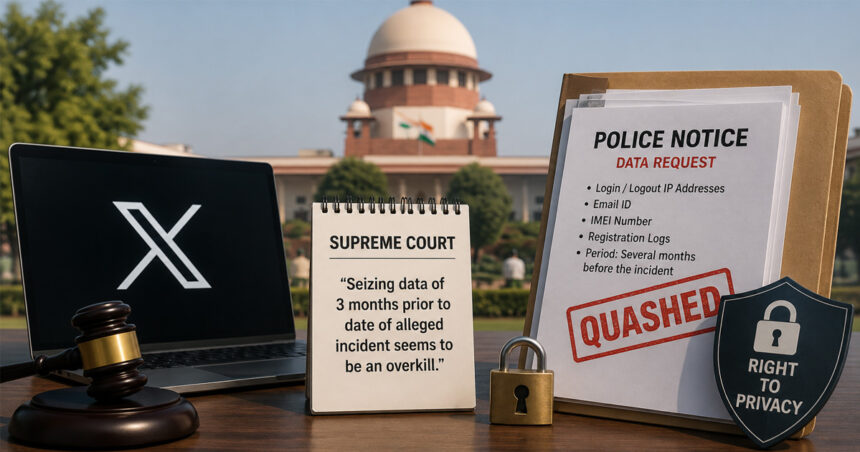
A Bench of Chief Justice Surya Kant and Justice Joymalya Bagchi held that personal data from the period before the alleged incident could not be sought, and that the State’s power to investigate must be balanced against an individual’s right to privacy.
The police cannot seek a person’s digital data for a period unconnected with the alleged offence. In a ruling on a journalist’s digital data, the Supreme Court on 14 October 2026 quashed a police notice that sought months of records from before the alleged incident.
In Abhishek Upadhyay v. State of Uttar Pradesh & Ors., a Bench comprising Chief Justice of India Surya Kant and Justice Joymalya Bagchi quashed a notice dated 22 August 2026. The notice had been issued by the Ghaziabad Police to the social media platform X, seeking the petitioner’s digital data.
Key takeaways
What happened : On 14 October 2026, the Supreme Court quashed a police notice to X seeking a journalist’s data for several months before an alleged road-rage incident.
The principle : Data sought must bear a reasonable connection to the offence. Personal data from before the date of occurrence cannot be obtained.
Relief : Interim protection from coercive action was made absolute, and data already obtained cannot be used against him.
What is next : The CJI indicated that guidelines on collecting digital data could be considered in an appropriate petition.
What was the case about?
The petitioner is an investigative journalist who had reported on alleged misappropriation of donations made for the Shri Ram Janmabhoomi Temple. A First Information Report was registered against him at Indirapuram Police Station, Ghaziabad.
The FIR alleged that he hit a motorcyclist with his car, threatened the complainant and made casteist remarks. He denies the allegations. He contends that the incident was staged in retaliation for his reporting. On 25 August 2026, the Supreme Court granted him interim protection from coercive action.
The notice to X
The police then issued a notice to X seeking data including login and logout IP addresses, his email ID, IMEI number and registration logs. The data covered a period of several months before the alleged incident.
The published reports do not specify the provision under which the notice was issued. During an investigation, a notice requiring a person or platform to produce a document or electronic record is ordinarily issued under Section 94 of the Bharatiya Nagarik Suraksha Sanhita, 2023 (BNSS). This provision replaced Section 91 of the Code of Criminal Procedure, 1973.
The Police Commissioner stated in an affidavit that the notice was intended to trace and investigate the petitioner. The Court found this explanation inconsistent with the nature of the information sought.
What did the Court say?
“Seizing data of 3 months prior to date of alleged incident seems to be an overkill,” Justice Bagchi observed. The Bench clarified that it was not questioning the statutory powers of the police, but the manner of their exercise.
“We are not against any rule. (We are concerned with the) manner of exercise of the power,” the Bench stated. It added that it would understand such a request if a conspiracy were alleged.
The Court held that “no confidential or personal information can be obtained prior to date of occurrence.”
Information relating to the period after the registration of the FIR cannot be sought “unless alternative measures are found to be inadequate.”
What directions did the Court issue?
The notice issued to X was quashed.
Any information obtained under the notice, or otherwise, shall not be used against the petitioner.
The interim protection from coercive action was made absolute, subject to his cooperation with the investigation.
The police were directed to release his seized vehicle within two days.
The petitioner was given liberty to challenge the FIR before the competent High Court. The Court expressed no opinion on the merits of the allegations.
On the broader question of guidelines for collecting personal and digital data during investigations, the Chief Justice indicated that the issue could be considered in an appropriate petition.
Why it matters for law students
The order applies the principle of proportionality to the collection of digital data during investigations. The Supreme Court recognised proportionality as part of the right to privacy in Justice K.S. Puttaswamy (Retd.) v. Union of India, (2017) 10 SCC 1.
Its central message is that the scope of data sought must bear a reasonable connection to the offence under investigation. The power to call for records under Section 94 BNSS is therefore not unlimited. The order shows that its exercise is open to judicial review on grounds of necessity and proportionality.
For journalists, whose digital records may reveal confidential sources, the order carries particular significance. For every citizen, it is a reminder that access to personal data by investigating agencies must be necessary, limited and justified.
What you can do now
Read the proportionality test in the Puttaswamy judgment alongside Section 94 BNSS.
When you draft a challenge to a data notice, focus on the period covered and its link to the alleged offence.
What we don’t know yet
No petition seeking comprehensive guidelines on digital data collection has been reported yet. It is also not yet known whether the petitioner will challenge the FIR before the High Court.
Frequently asked questions
Can the police ask social media platforms for a user’s data?
Yes. During an investigation, the police may require a person or platform to produce documents or electronic records, ordinarily under Section 94 BNSS. As this case shows, the request must be proportionate and connected to the offence being investigated.
What is the proportionality test?
It is a test for whether a State action that restricts a fundamental right is justified. The action must pursue a legitimate aim, be suitable and necessary for that aim, and be balanced against the right affected. The Supreme Court applied it to privacy in Puttaswamy (2017).
Was the FIR against the journalist quashed?
No. The Court quashed only the notice to X. It gave the petitioner liberty to challenge the FIR before the competent High Court and expressed no view on the merits.