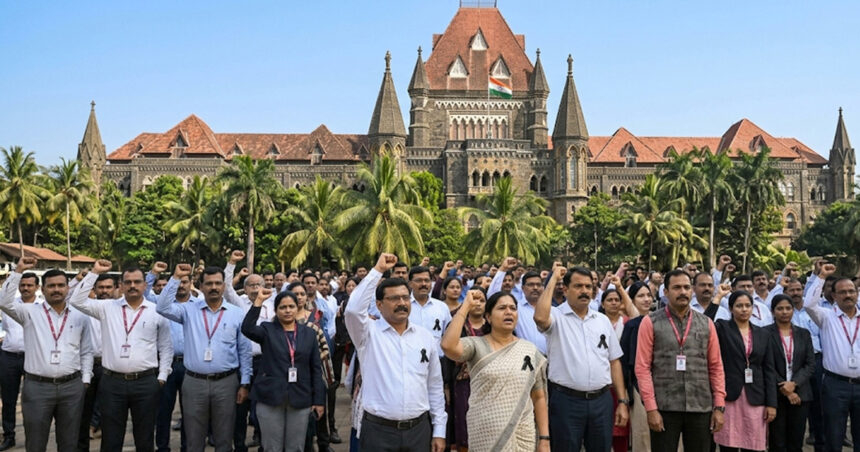
Demand for revised pay scales on the lines of Bombay High Court employees; clerks, peons, bailiffs and stenographers to participate in the protest. Court administration across district and taluka courts including Pune likely to be affected.
- Demand for Pay Parity and Removal of Salary Disparities
- High Court Committee Submitted Proposal to State Government on January 31 2025
- 34,500 Employees from Different Judicial Cadres to Participate
- From Black Ribbon Protests to Mass Leave: Timeline of the Agitation
- The major developments in the protest are as follows:
- How Will the Mass Leave Affect Court Proceedings in Pune and Maharashtra?
- The potential impact of the agitation includes:
- Indefinite Strike Could Further Complicate the Pendency of Cases
- State Governments Decision Now Crucial for Judicial Employees
Pune: 34,500 employees working in subordinate courts across Maharashtra are set to intensify their agitation over the long-pending demand for revised pay scales. Seeking parity with the salary structure and service benefits extended to employees of the Bombay High Court judicial staff across the state will proceed on leave on Thursday, November 5 2026.
Employees from Pune district are also expected to participate in the protest raising concerns over disruptions to routine administrative operations. Employee organisations have further warned of a strike from November 17 if their demands remain unresolved.
Demand for Pay Parity and Removal of Salary Disparities
The principal demand of the protesting employees is the implementation of revised pay scales for court staff on the lines of those applicable to employees of the Bombay High Court. The employee organisations maintain that there should be parity in salaries and service benefits based on the nature of duties and responsibilities performed by employees.
According to employee representatives the disparity between the pay structures of High Court employees and those working in courts has remained unresolved despite years of representations and follow-ups with the state government.
The demand is not limited to an increase in salaries. It also involves the restructuring of existing pay scales and the corresponding financial benefits for employees across cadres working in district and taluka courts.
High Court Committee Submitted Proposal to State Government on January 31 2025
A significant development in the matter is that a proposal concerning the revision of pay scales for court employees was submitted to the Maharashtra Government on January 31 2025 following consideration at the Bombay High Court level.
However employee organisations allege that despite the submission of the proposal the state government has not taken a decision on the matter. With 20 months having passed since its submission the continued delay has reportedly contributed to growing dissatisfaction among judicial employees.
Employee representatives claim that repeated representations and follow-ups have failed to produce an outcome. They are now demanding that the government approve the proposal and address the existing disparity in salary structures without delay.
34,500 Employees from Different Judicial Cadres to Participate
judicial employee organisations across Maharashtra are participating in the proposed agitation. These include the Bailiff Employees Federation, Stenographers Association, Group C Employees Federation and Group D Employees Federation.
According to reports the approximate cadre-wise distribution of employees involved in the agitation is as follows:
| Employee Category | Approximate Number |
|---|---|
| Peons | 7,००० |
| Stenographers | 2,००० |
| Bailiffs | 2,5०० |
| Clerks, Assistant Superintendents and Superintendents | 23,००० |
| Total | 34,5०० |
Clerical staff constitute the largest category among the employees participating in the agitation. These employees play a role in the daily functioning of subordinate courts including case registration handling judicial documents maintaining records and performing administrative responsibilities.
From Black Ribbon Protests to Mass Leave: Timeline of the Agitation
Before announcing the mass leave protest employee organisations had adopted forms of demonstration to draw the governments attention to their demands. Initially employees wore ribbons while performing their duties to register their protest. However with no decision forthcoming the organisations decided to escalate the agitation.
The major developments in the protest are as follows:
September 6 2026: Judicial employees across Maharashtra wore ribbons while attending to their duties as a mark of protest.
October 16. 17 2026: Employees continued their protest by wearing ribbons for two consecutive days.
November 5 2026: 34,500 judicial employees across the state are scheduled to proceed on mass leave.
November 16 2026: Some reports indicate this as the deadline given to the state government to address the demands.
November 17 2026: Employee organisations have warned of commencing a strike if their demands remain unfulfilled.
Employees in Nashik, Sangola, Alibag and Kalyan among locations have also participated in the agitation through various forms of protest.
How Will the Mass Leave Affect Court Proceedings in Pune and Maharashtra?
The proposed mass leave on November 5 is expected to affect the functioning of district and taluka courts across Maharashtra. In particular activities such as case registration, availability of records, service of summons and notices and implementation of court orders may face delays.
In Pune the participation of employees could affect administrative operations at the District and Sessions Court in Shivajinagar along with other subordinate courts across the district.
The potential impact of the agitation includes:
Delays in registering cases and processing applications.
Difficulty in making documents and judicial records available for hearings.
Delays in serving summons, notices and warrants.
Disruptions in the implementation of judicial orders.
Difficulties in coordination between litigants, advocates and court administration.
However there has been no confirmed announcement that all courts will remain completely closed during the mass leave protest. The actual extent of disruption will depend on employee participation and the administrative arrangements made by courts.
Indefinite Strike Could Further Complicate the Pendency of Cases
Courts across Maharashtra are already dealing with a backlog of pending cases. In circumstances an indefinite strike by judicial employees could further affect the administrative processes necessary for the smooth conduct of judicial proceedings.
Litigants involved in criminal cases bail applicants, witnesses and individuals regularly visiting courts for various procedural requirements could face additional difficulties.
Although judicial hearings may continue wherever the necessary arrangements are available the absence of supporting staff could affect the availability of documents, case records and other essential services required for the progression of proceedings.
Consequently resolving the employees demands while ensuring the uninterrupted functioning of the system is likely to become a significant challenge for the state government and the court administration.
State Governments Decision Now Crucial for Judicial Employees
With 34,500 judicial employees involved the agitation has emerged as a significant administrative issue concerning the functioning of Maharashtras subordinate judiciary.
The demand for revised pay scales on the lines of Bombay High Court employees, coupled with the pendency of the proposal submitted to the state government has brought the issue back into focus.
The governments response following the November 5 mass leave protest will be crucial, in determining the course of the agitation. Whether the government initiates discussions and resolves the matter before the proposed indefinite strike remains to be seen.
Employee organisations have maintained that unless their demands are addressed they are prepared to intensify the agitation by commencing a strike from November 17 2026.