A recruiter or advocate may read your email in under a minute. A good internship email for law firm applications is short, specific and easy to say yes to. This guide covers what to include and what to avoid. It ends with samples you can adapt, for a law firm, an advocate’s chamber and an NGO.
- How to apply for a law internship: which route should you use?
- Cold email for internship: what should it include?
- Internship application email sample: what does a good one to a law firm look like?
- Email to advocate for internship: what should you write?
- How do you write a subject line that gets opened?
- How do you write the “why them” line?
- What if you have no internship experience yet?
- Sample: a short email to an NGO
- How should you follow up?
- What should you do?
- What should you avoid?
- When should you send it?
- Frequently asked questions
Key takeaways
- Keep it short: about 120 to 180 words in the body.
- Be specific: your year, the dates you want, the team or kind of work, and one real reason for choosing them.
- Attach a one-page CV as a PDF, and a writing sample only if asked.
- Follow up once, about two weeks later, and then move on.
How to apply for a law internship: which route should you use?
Before you write, check how the firm or office wants applications. Many law firms list an internship or careers email address, or an online form, on their website. If they do, use it. A cold email to a partner, when the firm has a formal process, may simply be forwarded or ignored.
Cold emails work best for:
- advocates’ chambers and smaller firms with no formal process;
- NGOs and research organisations;
- specific teams, when you have a genuine connection to their work.
Cold email for internship: what should it include?
- A clear subject line: “Internship application: [Your name], 4th year BA LLB, December 2026”.
- Who you are: your name, college, course and year, in one sentence.
- What you want: the dates and, if relevant, the practice area.
- Why them: one specific, honest reason. A case they argued, an area they work in, or a recommendation from someone you name.
- What you offer: one or two concrete things, such as research or drafting experience from an earlier internship.
- A polite close: thank them, and mention that your CV is attached.
Internship application email sample: what does a good one to a law firm look like?
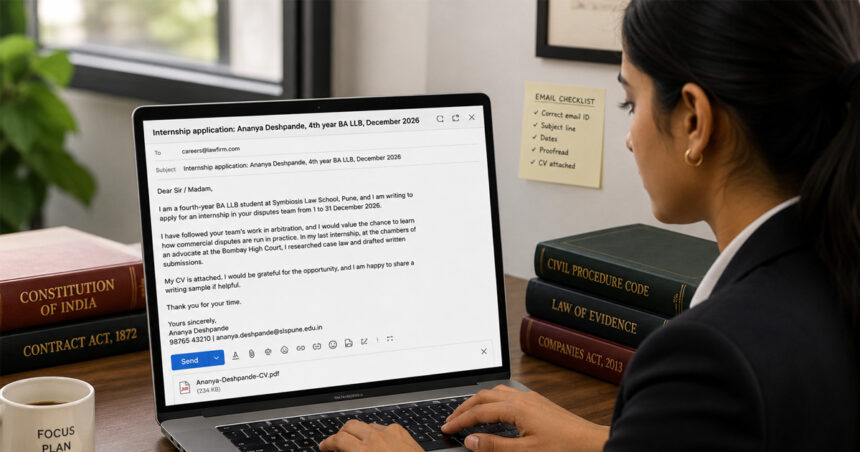
Subject: Internship application: [Your name], 4th year BA LLB, December 2026
Dear [Recruitment team or name],
I am a fourth-year BA LLB student at [College name], Pune, and I am writing to apply for an internship in your disputes team from 1 to 31 December 2026.
I have followed your team’s work in arbitration, and I would value the chance to learn how commercial disputes are run in practice. In my last internship, at the chambers of an advocate at the Bombay High Court, I researched case law and drafted written submissions.
My CV is attached. I would be grateful for the opportunity, and I am happy to share a writing sample if helpful.
Thank you for your time.
Yours sincerely,
[Your name]
[Mobile number] | [College email address]
Email to advocate for internship: what should you write?
Subject: Request for internship in your chambers: [Your name], 3rd year LLB, January 2027
Respected Sir / Madam,
I am a third-year LLB student at [College name], and I would like to request an internship in your chambers for four weeks in January 2027.
I am keen to learn civil litigation in the district courts, and I have read your work in [area of practice, if you genuinely know it]. In my earlier internship with the District Legal Services Authority, I helped draft applications for legal aid.
My CV is attached. I will be glad to work on any research or drafting you assign.
Thank you for considering my request.
Yours faithfully,
[Your name]
[Mobile number] | [College email address]
How do you write a subject line that gets opened?
The subject line decides whether your email is opened. Put the essentials in it: your name, your year, the word “internship” and the month you want.
- Strong: “Internship application: Priya Kulkarni, 4th year BA LLB, December 2026”
- Weak: “Internship request” or “Hello Sir”
If someone referred you, add their name: “Referred by Professor [Name]: internship application, December 2026”. A named referral is one of the strongest openers you can have.
How do you write the “why them” line?
This one sentence shows that you are not mass-mailing. Make it specific and true.
- Strong: “I read your team’s work on the recent insolvency resolution of a Pune textile company, and I would like to learn how such cases are run.”
- Weak: “Your firm is one of the best in India.”
If you cannot find anything specific about a firm or chamber, you probably do not know enough to apply there yet. Read their website or recent judgments first.
What if you have no internship experience yet?
Write about what you have done. Moots, research papers, legal aid camps and relevant coursework all count. A first-year student can honestly say: “I am in my first year and keen to learn how a district court works. I have taken part in my college’s legal aid camps.”
District courts, legal aid clinics and NGOs are the usual first steps. Our winter internship guide lists where to start.
Sample: a short email to an NGO
Subject: Internship application: [Your name], 2nd year BA LLB, January 2027
Dear [Name],
I am a second-year BA LLB student at [College name], and I would like to apply for a four-week internship with your legal team in January 2027.
Your work on access to education for children from migrant families is close to the issues I have been studying in my constitutional law course. At college, I help run our legal aid committee’s awareness camps in nearby villages.
My CV is attached. I would be glad to help with research, case documentation or awareness work.
Thank you for your time.
Yours sincerely,
[Your name]
[Mobile number] | [College email address]
How should you follow up?
Wait about two weeks. Then reply to your own email, so that the original stays in the thread, with a short note:
“Dear [Name], I am writing to follow up on my internship application below for December 2026. I would be grateful to know if there is an opportunity. Thank you for your time. [Your name]”
Send one follow-up only. If there is still no reply, move on.
What should you do?
- Address the right person by name where you can.
- Proofread twice. Check that the firm’s name is spelt correctly.
- Name the PDF file clearly, for example “Firstname-Lastname-CV.pdf”.
- Send from a professional email address.
- Mention the exact dates you want in both the subject line and the body.
What should you avoid?
- Do not send the same email to many firms with everyone in the “To” or “CC” field.
- Do not copy-paste a generic paragraph about “passion for law”.
- Do not ask about the stipend in the first email.
- Do not send repeated follow-ups. One polite reminder is enough.
- Do not use informal greetings such as “Hi” or “Hey” in a first email.
- Do not attach several large files. One CV, and a writing sample only if asked, is enough.
When should you send it?
In our view, two to three months ahead is safe for law firms, and four to six weeks ahead is usually enough for chambers. If you can, send it on a weekday morning, when it is more likely to be read. Our winter internship guide has a full timeline.
Frequently asked questions
How do I write an email to a law firm for an internship?
Keep it short. Say who you are, the dates you want, why you chose that firm, and what you can offer, and attach a one-page CV. Use the firm’s official application route if it has one.
How long should an internship email be?
About 120 to 180 words in the body. Recruiters read many emails, so a short, specific one stands out.
Should I follow up if a law firm does not reply?
Yes, once, about two weeks later, with a short and polite reminder. If there is still no reply, move on to other applications.
Can I email an advocate directly for an internship?
Yes. Many advocates’ chambers have no formal process, so a short, respectful email is the normal way to ask. Address them properly, give your dates and year, and attach your CV.
Should I attach a writing sample?
Only if the firm asks for one, or if you mention that you can share one on request. Keep it short, and make sure it is entirely your own work.