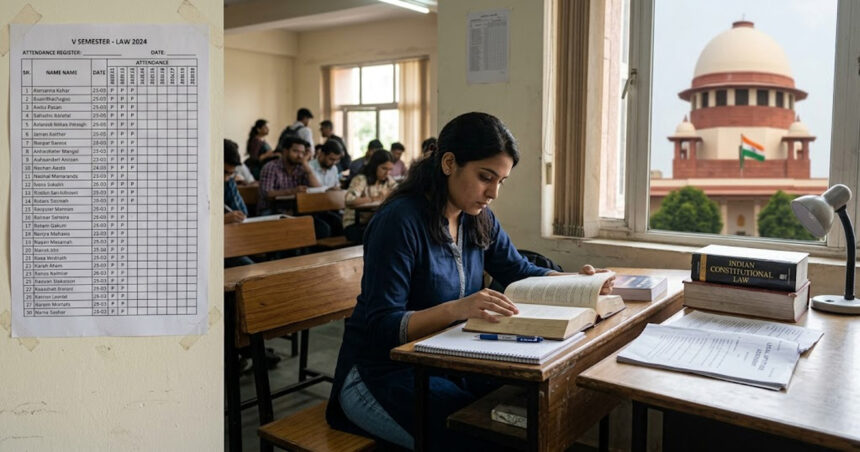
With judgment reserved on 6 October, the Supreme Court is set to settle a question that concerns every law student in the country: can a student be kept out of the examination hall for falling short on attendance?
For nearly a decade, one question has followed Indian legal education from the classroom to the courtroom. Should a law student who has not attended enough lectures be stopped from writing examinations? On 6 October 2026, the Supreme Court reserved its judgment on that question. Its answer will shape how every law college in India runs its classrooms.
A three-judge Bench of Justice Vikram Nath, Justice Sandeep Mehta and Justice Augustine George Masih heard appeals filed by the Bar Council of India (BCI) and SVKM’s Narsee Monjee Institute of Management Studies (NMIMS) against a judgment of the Delhi High Court delivered on 3 November 2025. The parties have been permitted to file written submissions within two weeks.
A Case That Began With a Loss
On 10 August 2016, Sushant Rohilla, a third-year law student at Amity Law School, Delhi, died by suicide after he was barred from his semester examinations for low attendance. The Delhi High Court later took up the matter on its own motion. What began as an inquiry into the death of one student grew into a wider examination of attendance rules in legal education across the country.
In its judgment, the High Court held that no student enrolled in a recognised law college, university or institution in India shall be detained from taking examinations on the ground of lack of minimum attendance. It observed that attendance norms “cannot be made so stringent that they lead to mental trauma, let alone the death of a student”, and that legal education “cannot be reduced to classroom attendance”.
The High Court directed the BCI to reconsider its attendance requirements for the three-year and five-year LL.B. programmes, and required institutions to constitute Grievance Redressal Committees. Under the interim arrangement it laid down, colleges could reduce a student’s grades by a limited margin for poor attendance, but could not keep the student out of examinations.
The Road to the Supreme Court
BCI rules require law students to maintain a minimum of 70 per cent attendance. The BCI and NMIMS challenged the High Court’s ruling, contending that the removal of mandatory attendance undermines academic rigour, institutional autonomy and professional standards in legal education. They also pointed to a rise in litigation by students seeking permission to appear for examinations despite attendance shortfalls.
On 13 May 2026, the Supreme Court declined to suspend the judgment, stating: “We will hear the matter, decide and lay down the correct position of law.” On 26 May, however, it stayed paragraph 249 of the High Court’s judgment, which barred institutions from detaining students for insufficient attendance. The stay operates prospectively.
The Bench has not concealed its reservations. Justice Mehta expressed concern that the ruling could become a “free pass” for non-attendance, and the Bench had earlier remarked that the High Court’s approach gave “a premium to students lacking discipline”.
The issue has also reached closer to home. In May 2026, the Bombay High Court permitted students of ILS Law College, Pune, who had fallen short of the attendance requirement to appear for their semester-end examinations, while making their results subject to the outcome of their pending petitions.
Two Concerns, Both Legitimate
The case for attendance is not a matter of mere formality. The classroom is where a law student first learns to reason aloud, to be questioned and to defend an argument. The profession that awaits them is unforgiving of absence; a court does not wait for counsel who fails to appear. Regulators are entitled to insist that a law degree reflects sustained engagement with the discipline.
Equally, the law student of today does not learn in the lecture hall alone. Internships, moot court competitions and legal aid clinics form a substantial part of legal training, and these are precisely the forms of practical exposure the High Court sought to protect. A fixed percentage, applied without regard to illness, family circumstances or genuine hardship, risks penalising the very students who most need support. The circumstances that gave rise to this litigation are a sobering reminder that an attendance register, enforced without discretion, can carry consequences far graver than a missed examination.
The Way Forward
The question before the Supreme Court, therefore, is not whether attendance matters. It plainly does. The question is whether attendance should be the sole gatekeeper to the examination hall. In our view, a durable resolution would retain a meaningful minimum standard while guaranteeing a fair, transparent and time-bound process for exceptions, supported by grievance mechanisms that function in practice and not merely on paper.
Until judgment is delivered, the High Court’s protection against detention remains stayed. Students would therefore be well advised to treat their institution’s attendance requirements as binding and to document any circumstances that may affect their attendance.
Whatever the outcome, the judgment will be read closely in every law college in India. For a profession founded on the principle that every person deserves a fair hearing, it would be fitting if the rules governing those who aspire to join it reflected the same principle.