


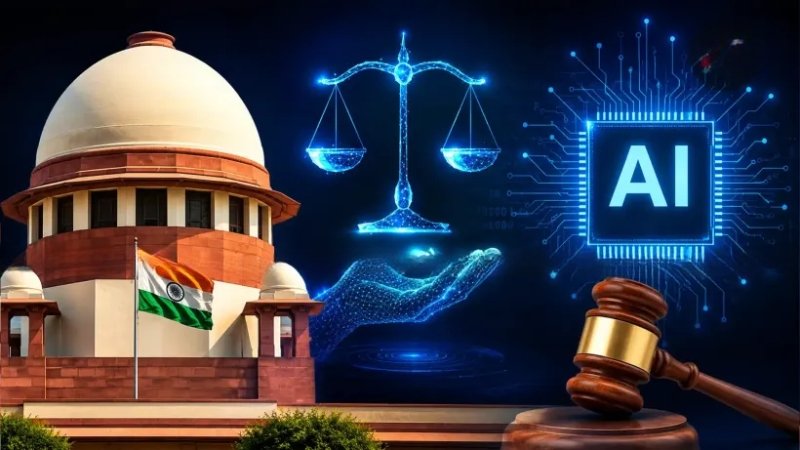
The Supreme Court of India’s specialized AI Committee has taken a historic leap into the future by officially publishing the draft Regulations for Use of Artificial Intelligence in Courts, 2026. This highly anticipated framework opens the door for advocates, legal researchers, and common litigants to integrate advanced machine learning tools into their daily court preparations, marking a major shift in how the Indian legal system handles massive document loads.
The draft rules outline a clear boundary: while lawyers are free to use AI tools to draft petitions, analyze voluminous case records, and predict litigation trends, they must explicitly include a formal disclosure statement in their court filings detailing which parts of their work were assisted by algorithms. The Supreme Court has made it non-negotiable that the core human elements of justice—the interpretation of tricky points of law, the evaluation of human testimony, and the final delivery of judgments—must remain solely within the hands of human judges.
This regulatory move is aimed at tackling the millions of pending cases across local and regional courts by cutting down the time it takes to perform legal research. However, the draft regulations introduce strict liability clauses. If an AI tool creates a fake case citation—a digital phenomenon known as a hallucination—the human advocate signing the petition will face full professional misconduct penalties and contempt of court proceedings. The public consultation phase is now open, allowing bar councils and technology experts to submit feedback before the guidelines become binding national law.