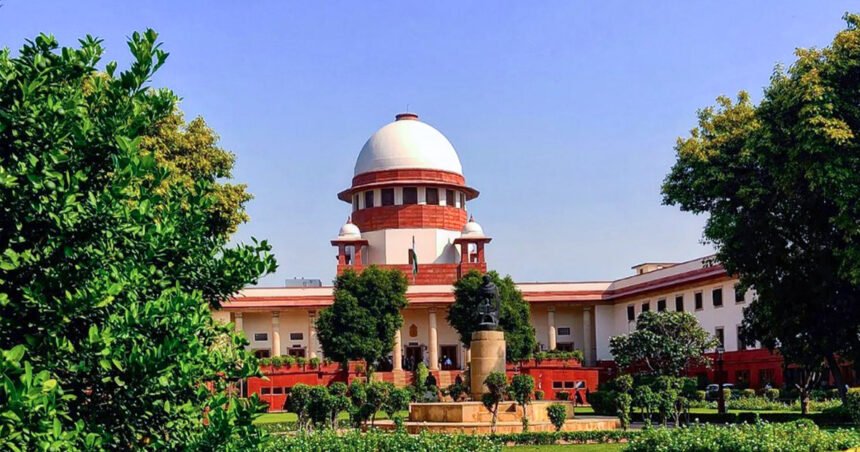
A consensual relationship cannot be turned into rape after the fact just because it ended badly, the Supreme Court held on 30 October 2026. A bench of Justices B.V. Nagarathna and R. Mahadevan discharged a Kerala man accused of rape, cheating and bigamy by a woman he had lived with from 1996 to 2003.
The judgment, written by Justice Nagarathna, is Santhosh Kumar N.P. v. State, Station House Officer, Kadirur Police & Anr., 2026 INSC 1179.
Key takeaways
What happened: The Supreme Court set aside orders of the Kerala High Court and a sessions court that had refused to discharge the accused, and discharged him of all charges.
Who is affected: Anyone facing or filing criminal complaints arising from a relationship, and the courts deciding discharge applications.
Why it matters: The court drew a line between consent obtained by deceit, which can be rape, and regret after a relationship fails, which is not.
What to read: Paragraphs 42 to 46 and 58 to 60 of the judgment.
What were the facts?
The woman had earlier been married and divorced. She said the man presented himself as a bachelor and married her at a temple in Mysuru in 1996. They lived together until 2003. She later learnt that he was already married, with two children.
After a domestic violence complaint was dismissed in 2009, she filed private complaints. One led to FIR No. 503 of 2011 at Kadirur police station in Kerala. The charges were under Sections 376 (rape), 420 (cheating), 493 (cohabitation by deceit), 494 (bigamy) and 495 (bigamy with concealment) of the Indian Penal Code.
The sessions court refused to discharge him in January 2015. The Kerala High Court upheld that on 21 May 2025. The Supreme Court stayed the trial in July 2025 and has now allowed his appeals.
What did the Supreme Court decide?
The court found that the man’s brother had told the woman about the earlier marriage within months of their living together. Yet she continued the relationship for years. On that record, her claim that she believed she was lawfully married could not be accepted. The relationship “was evidently one of consensual relationship”, the court said (para 42).
It held that hindsight alone cannot turn a consensual relationship into a crime (para 43). “Rape, being a heinous offence, must be reserved for situations where there is real sexual violence,” the bench said (para 45). And “the justice system must not be turned into a tool of vengeance when relationships fail” (para 46).
The other charges also failed:
Cheating (Section 420): no property had been delivered and no valuable security created, so the offence was not made out (paras 49 to 51).
Cohabitation by deceit (Section 493): she continued living with him after learning of the earlier marriage, so she could not have been acting on a belief that they were lawfully married (para 53).
Bigamy (Sections 494 and 495): the evidence of the temple ceremony did not show a valid marriage, which these offences require (para 56).
Does this mean a false promise of marriage is never rape?
No. The court said this clearly. In Indian society, consent to a relationship may rest on the belief that it will lead to marriage (para 58).
Where a woman is genuinely kept in the dark about a man’s existing marriage, her consent may be vitiated. That must be decided on the facts and the evidence, not on presumptions (para 59).
What the court rejected was using criminal law after a relationship ends. “Criminal law cannot be used as munitions to settle personal scores, exact revenge or coerce an individual,” it said (para 60).
Why it matters for law students
The test for discharge. At the stage of framing charges, a judge may sift the evidence for a prima facie case. But the judge cannot act as a “mouthpiece of the prosecution”. The court applied Union of India v. Prafulla Kumar Samal (1979) and Sajjan Kumar v. CBI (2010) on this.
This is Section 227 of the old Code of Criminal Procedure, now Section 250 of the Bharatiya Nagarik Suraksha Sanhita, 2023. Our guide to writing case briefs shows how to brief a discharge order.
What changed under the BNS. The case was charged under the IPC because the events took place long before July 2024. Under the Bharatiya Nyaya Sanhita, 2023, rape is now in Section 64, cheating in Section 318, cohabitation by deceit in Section 81, and bigamy in Section 82. The BNS also adds Section 69, which separately punishes sexual intercourse obtained through deceitful means, including a false promise of marriage. In our view, this judgment will be read alongside Section 69 in future cases.
Consent and deceit. Keep two ideas apart in your answers: consent that never existed because it was obtained by deceit, and consent that existed but is regretted later. This judgment is a clear statement of that line. For another recent Supreme Court ruling on how courts read the law, see our explainer on the KPSC 2011 recruitment judgment. Our legal research toolkit shows where to find the full text.
What we don’t know yet
Whether the complainant will seek a review.
How courts will apply this reasoning to cases charged under Section 69 of the BNS.
Frequently asked questions
What did the Supreme Court hold in Santhosh Kumar N.P. v. State?
That intimacy in a consensual relationship cannot later be treated as rape just because the relationship ended. It discharged the accused of rape, cheating, cohabitation by deceit and bigamy charges.
Is sex on a false promise of marriage still an offence?
It can be. The court said consent may be vitiated where a woman is genuinely deceived, which must be decided on evidence. Section 69 of the Bharatiya Nyaya Sanhita, 2023 also separately punishes sexual intercourse obtained by deceitful means, including a false promise of marriage.
What is a discharge in criminal law?
A discharge ends a criminal case before trial, when the court finds there is not enough material to frame charges. It is different from an acquittal, which comes after a full trial.
Who decided the case?
A bench of Justices B.V. Nagarathna and R. Mahadevan, on 30 October 2026. Justice Nagarathna wrote the judgment.