



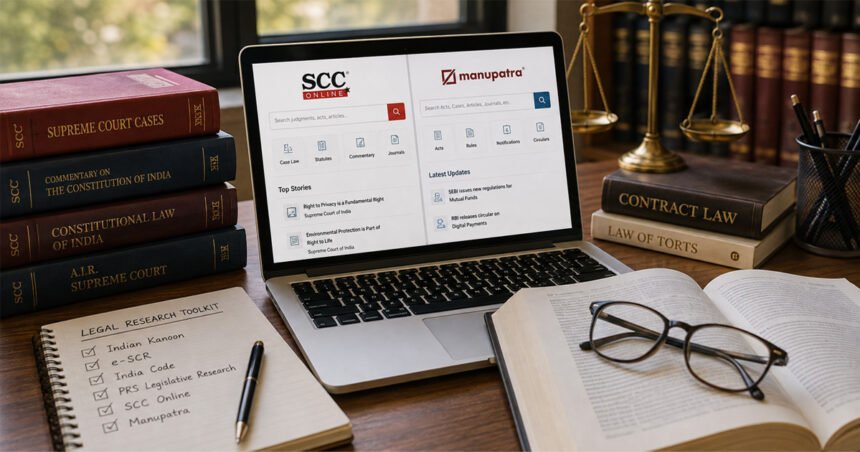
If you ask first-year law students what legal research means, they will answer something like searching for cases online. That answer is not wrong. It is incomplete. Legal research is a set of habits, platforms and shortcuts that become faster and more reliable the earlier they are practiced. If you wait until your year to learn SCC Online or citation rules, you will spend internships relearning what your classmates already know.
This guide is practical and free of fluff. It shows how to set up the research toolkit in year one, not only why it matters but also exactly what to do.
Legal research skill compounds.
A student who learns to use SCC Online connectors and Manupatra notification tracker in a year is not only saving time on moot memos but also building instincts that help case law make sense faster in every subject that follows, from Constitutional Law to Arbitration.
There is also a reason to begin early. Most Indian law schools give students institutional access to SCC Online and Manupatra through the library. That access is usually used casually for moot citation instead of systematically. Students who treat SCC Online and Manupatra as skills to be trained, not as tools to be searched when stuck, receive more value from the same subscription.
Most guides jump straight to SCC Online and Manupatra. Skipping that step means missing something; research must first happen on free open platforms. Those free platforms are what will be available on the day institutional login expires during bar exam preparation, practice years or any period without a subscription.
Build fluency with these before you lean on paid databases:
– Indian Kanoon, a full-text searchable database of Indian judgments. Good for verification and for practising search-string logic without worrying about “wasting” paid database credits.
– e-SCR (Supreme Court’s own judgment portal), the Supreme Court’s free repository of its own judgments now carrying neutral citations. When it was launched, then Solicitor General Tushar Mehta remarked that “e-SCR is as good as SCC now “, which is a reminder that a “free” source can be authoritative and it is not automatically inferior to a subscription database.
– India Code: the government’s official repository of central and state legislation searchable by title, keyword and year.
– PRS Legislative Research: full text of bills with bill-tracking, useful when you need to see how a law changed between its introduction and passage.
This combination of Indian Kanoon, e-SCR India Code and PRS, plus other open resources, is what university law libraries suggest to students. They see these resources as complements to subscription databases, not substitutes for research skill itself, as shown in library guidance from institutions such as Yale Law School’s Library.
Build this habit now. Whenever you find a case on SCC Online or Manupatra, cross‑check it on Indian Kanoon or e‑SCR before citing it in an assignment. This not only catches transcription errors but also trains you to verify instead of trusting blindly. Examiners and seniors notice this habit.
One important distinction exists. Use sites only to search and verify, not to cite. Most professors and moot judges do not treat Indian Kanoon or similar crowd‑indexed portals as sources; they are aggregators, not publishers of record and they lack the editorial checks that SCC or a reporter provides. Therefore, the workflow should run in one direction: find or double‑check a case on Indian Kanoon, then pull the actual citation from the reporter or the SCC Online/Manupatra reference and the neutral citation, where it exists, from a credible recognised source before including it in written work. Treat platforms as research aids and treat SCC Online, Manupatra and official reporters as mandatory citation sources.
Layer Two: SCC Online Used Right, Not Used
SCC Online is usually the first paid database that Indian law students access. Most people use SCC Online the way they use Google: type a few words, click the first result that looks relevant and finish. This is a waste of everything that SCC Online actually offers.
What must actually be learned on SCC Online during the year?
1. The Case Status / Citator tool. Before you cite any case, you should check whether that case has been followed, distinguished or overruled. This check is the most common error that law students make when writing memos and papers. Many students cite a proposition of law from a case that has already been overruled simply because they never looked at the case’s history. SCC Online displays the status of a case directly next to the case name so you can see at a glance whether the case is still law.
2. Boolean and proximity connectors. Instead of typing a sentence into the search bar and hoping for results, learn connectors such as AND, OR, W/n (within n words) and phrase search using quotation marks. For example, searching for ” assembly” AND “common object” W/5 “Section 149” returns far more precise results than typing the same words as a simple sentence. This technique teaches you to think like a researcher framing an issue rather than like someone who simply Googles a fact.
3. Headnotes before text. SCC’s headnotes are professionally written summaries of the proposition in a case. Reading the headnote first before you dive into forty paragraphs of judgment text is the way practising lawyers triage dozens of results quickly. Students who skip headnotes and read every case end up slower and less accurate because they lose the thread of what the case actually decided.
4. The “Cited By”. Statute‑linked commentary. If you are researching a section of a statute, for example Section 34 of the Arbitration and Conciliation Act, SCC Online links that bare section to case law that interprets it and to commentary. This is more useful than searching case law and statute separately because it shows you how courts have actually read the provision.
A common year‑one mistake
Students often search SCC Online for a case they already know the name of, find it and stop without checking what that case cites or what has cited it since. Legal research is not “find the one case”; it is “map how a proposition of law developed.” Practice tracing that chain when an assignment only technically requires one authority.
Layer Three: Manupatra Where It Complements, Not Duplicates SCC Online
Manupatra is often treated as “the SCC Online,” which undervalues it. The two platforms overlap heavily on case law. They are strongest in different places.
Manupatra tends to be the tool for:
– Notifications, circulars and regulatory material useful for corporate law, tax, IP and compliance‑heavy internships where you need the latest RBI circular or SEBI notification, not just case law.
– International and foreign law content, useful for law papers and moots with a cross‑border dimension.
– Law journal and article access, which is often what you actually need when writing a seminar paper rather than a case comment.
Practical rule for year one: if your research question is “what does the law say and how has it been applied”, start on SCC Online. If it is “what’s the latest regulatory position or is there scholarly commentary”, check Manupatra. Running the search on both and comparing results occasionally not every time is also a good way to learn each platform’s blind spots.
The mistake to avoid
Don’t assume both databases index everything well. Tribunal orders, some High Court judgments and certain older material can appear on one platform and not the other or with incomplete coverage. If a search on SCC Online returns nothing, try Manupatra before concluding the material does not. Vice versa.
Citation Basics: What Actually Trips Students Up
Citation is where law students lose marks not because the concept is hard but because Indian legal citation is genuinely inconsistent and nobody tells first‑years that upfront.
There is no Indian Bluebook
Unlike the US, where The Bluebook is close to a universal standard, Indian law journals use a patchwork of citation styles. A useful survey by Indian found that among leading Indian law journals, styles range from different editions of the Bluebook to OSCOLA to the Chicago Manual of Style to journal‑specific standards developed independently by institutions such as NUJS and NLSIU. Even Bluebook‑following journals differ on which edition (18th, 19th or 20th) they require.
What this means in life: do not think that the citation style you used for your first moot memo will also fit a journal article or that the format considered correct by one law school is the same everywhere. Before you format any submission, whether it’s a moot memorandum, seminar paper or journal draft, look at the citation guide of that particular publication first. Although it seems obvious, this is the common reason why a well‑written piece loses points or is returned for revision.
Learn Bluebook’s India‑specific table early.
If your institution follows the Bluebook (which most do in some editions) do not try to reverse‑engineer an Indian case citation from the US examples in the text. The Bluebook contains a table for foreign jurisdictions, including India, that shows the correct format for Indian cases, statutes and reporters. Learning to find and use that table in your year instead of copying a senior student’s memo format and hoping it is still correct will save you from repeating small errors for years.
The neutral citation system changed the game in 2023. Many citation guides that were written before mid‑2023 do not reflect this change. In July 2023, the Supreme Court of India introduced a citation system giving each judgment a unique publisher‑independent citation in the format 2023 INSC 1 year court abbreviation, sequential number starting with judgments from 2014 onward and later extended backwards to 1950. The Court confirmed this in its notice.
Why does this matter for your toolkit?
A neutral citation does not depend on which law reporter—SCC, AIR or others—you have access to. It is assigned by the Court itself. Is the same whether you find the judgment on SCC Online, Manupatra or the Court’s free e‑SCR portal. For Supreme Court judgments, make it a habit to record the neutral citation together with the traditional reporter citation required by your institution’s style guide. You will see both citations used side by side in practice, and several High Courts Delhi, Kerala, Madras, Bombay—have also adopted their neutral citation systems.
Common citation mistakes to fix
– Citing the database instead of the reporter. The phrase “Available on SCC Online” is not a citation; it only tells where you found the case. Cite the reporter—SCC, AIR or the neutral citation in the manner required by your style guide.
– Citing a free aggregator site as the source. It is fine to look up a case on Indian Kanoon or a similar portal for a check, but putting “Indian Kanoon” in the footnote instead of the reporter citation is a habit that many professors punish because these sites are not regarded as authoritative publishers. Use them to locate the case, then cite it from SCC Online, Manupatra or the official reporter.
– Inconsistent short‑forms. If you introduce a case with a form after its first full citation, use that short form consistently. Do not switch between “the Kesavananda case,” “Kesavananda Bharati ” and “the fundamental rights case” within the paper.
– Skipping pinpoint citations. Citing a 60‑page judgment when you intend to refer to a single paragraph forces the reader to search for your point. Always cite the paragraph or page from which your proposition originates.
– Copying a ’s citation format without checking whether it is current. Formats change between editions and between journals. What worked for a paper two years ago may not match the guidelines for this year’s submission.
Turning This into a System, Not a One‑Time Read
Reading about a toolkit does not create one. Here is how you can actually make these practices stick during your year:
– Keep a personal citation crib sheet. A single document in Google Docs or Notion is sufficient for your institution’s required citation formats for cases, statutes, books and articles, with one worked example of each. Update the sheet whenever a professor or journal editor corrects your formatting.
– Run a 20‑minute drill. Choose one section of a statute you are currently studying and trace its interpretation: search it on SCC Online, check the “Cited By” list, read two or three headnotes, then verify one case on Indian Kanoon. This single habit, repeated each week, builds research speed faster than a one‑off workshop.
– Save your search strings, not your results. When a Boolean search on SCC Online or Manupatra works well, save the search string somewhere. You will reuse variations of that logic across subjects for years.
Verify before you cite every time. Make “check the citator” a step before any case goes into a memo, paper or moot submission; do not treat it as an occasional precaution. Internships and moot courts reward this type of research discipline. It is far easier to form this habit in the year when there is no deadline pressure than to try to retrofit it in the third year during placement season.
The Takeaways
You do not need to master every feature of SCC Online and Manupatra by the end of the year. You need three things in place. First, be comfortable moving between databases and paid databases depending on what you actually need. Second, develop a habit of checking a case’s history before you cite that case. Third, keep a citation reference that you trust and update regularly. Build those three things now and every research task for the rest of law school and, for any internship that follows, will become measurably faster.