



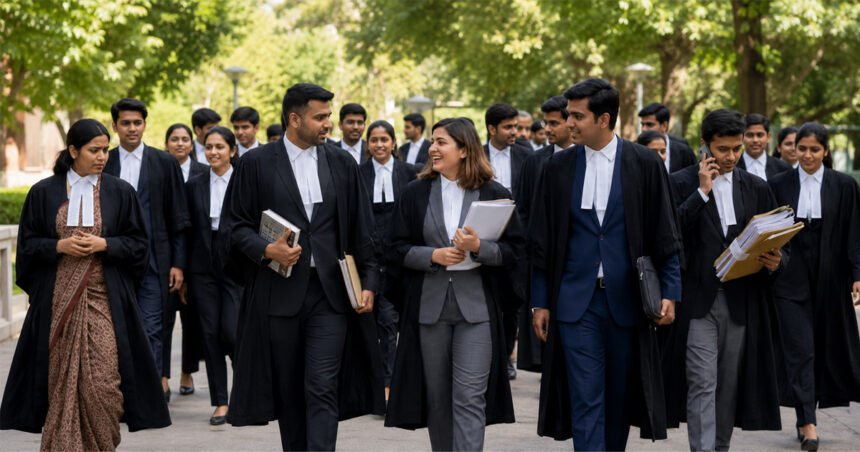
If you are a law student who has typed “law internships near me” into Google at two in the morning or asked an AI chatbot “how to apply for a law internship as a first-year student”, you are not alone. In fact, you are one of lakhs of students across India’s fifteen hundred law colleges doing the same thing tonight. This article exists because that search never leads to an honest answer. It leads to a catalogue, outdated internship portals and vague advice like “build your CV” or “network more”. Nobody actually tells you why you are failing and what to do differently. So here it is, without the diplomacy.
The Problem Nobody Names Out Loud
Spend twenty minutes on law student forums, LinkedIn comment sections or law-focused subreddits, and a pattern jumps out immediately. Students are not struggling because they lack sincerity or intelligence. They are struggling because the entire system of getting an internship in India is unstructured, undocumented and run almost entirely on luck and connections.
The common complaint is silence. Students send out fifty, a hundred internship applications and hear back from almost none of them. On community forums, senior associates and even partners have openly admitted that they get flooded with identical copy-pasted emails every single day, most of which get deleted without being opened. One former law firm partner put it plainly: hundreds of students send the templated cover letter addressed to “Dear Sir/Madam ” to as many email addresses as they can find, and none of it gets read properly. The tragedy is that the students sending these emails have no way of knowing this because their own college never told them how hiring actually works on the side.
The second complaint, as common, is the total absence of institutional support. Students from law colleges and even from some newer National Law Universities have spoken openly about having no placement or internship cell worth the name. Nobody teaches them how corporate law differs from litigation, how to identify which kind of internship will actually teach them something or how to write an application that a busy HR person will actually read. First-generation lawyers, students whose families have no background, are hit the hardest here because they have no uncle who is a judge and no family friend who is a partner at a firm.
The third complaint is exploitation once they do get in. Interns, first-timers describe being treated as free labour: no stipend, no real mentorship and work that consists of scanning documents and making tea rather than any actual legal exposure. This happens because desperate first-year students will accept any internship just to have something to put on their CV, and some organizations know this and take advantage of it.
If any of this sounds familiar, understand this clearly: the problem is not you. The problem is that nobody in the education ecosystem has bothered to explain the actual hiring process to students before throwing them into it.
Why the Usual Advice Fails You
Advice you will find online tells you to “apply on Internshala”, “update your LinkedIn”, or “cold email everyone.” None of this is wrong. None of it is precise either, and precision is what actually gets you an internship.
Cold emailing, for instance, does work. Only when done correctly, and almost every guide skips the part that actually matters. In the experience of some legal professionals, a generic mass-sent email is worse than not sending one at all because it signals laziness. What works is research. Find the lawyer or the specific team whose work you are actually interested in, mention a case or an article of theirs that you engaged with and keep your email to a few honest lines.
A recurring observation among some litigators is that a short, specific, timed email beats a polished but generic one every single time. Timing matters too. Lawyers tend to clear their inboxes in the week, so a Monday or Tuesday morning email has a better chance of being seen than one sent late on a Friday.
The deeper issue, though, is that first-year and second-year students are applying to the wrong kind of internship altogether. This is where I want to give you an opinion, not a non-answer.
Where Should You Intern First? An Honest Opinion
If you are a first-time intern understanding how law actually works, do not necessarily start with a law firm. I know this goes against what many seniors tell you, and I know a big firm name looks impressive on a CV. Here is the reasoning.
Large corporate law firms can compartmentalise interns heavily. As a second-year student with limited prior exposure, you may be given research tasks, asked to summarise documents, proofread drafts or compile case law with limited visibility into how a matter actually moves, how a client is handled or how a lawyer approaches a problem. You may learn how to use SCC Online a little. You may not necessarily learn how law functions as a living, moving system.
Instead, for an internship, consider working under a practising litigator at a district court or, where available, at a High Court. Working directly with an advocate can provide a different kind of exposure from working within a large firm.
Here is why that can matter –
A litigator’s chamber is where you can see law unfold in time. You may observe how a plaint is drafted because a client has arrived with a problem. You can sit in court, watch cross-examinations, observe how judges respond to arguments and understand the difference between what a bare Act says and how it is applied in a courtroom. You can also begin to understand how clients behave, how fees are discussed, how a case file is built and how much legal practice involves managing people as well as legal issues. This does not mean corporate internships have any value. It means the type of exposure to a first-time intern can differ significantly depending on the workplace, the supervising lawyer and the work assigned.
There is also a reason to consider district-court and individual-advocate internships early in law school. They may be more accessible to a first-time applicant without an established network. A local advocate may not have an HR department filtering hundreds of applications. A drafted email or, where appropriate, a respectful visit to a chamber may therefore create an opportunity that would otherwise be difficult to access. Importantly, an early internship should give you something you can carry forward: basic practical exposure, confidence, professional references and a clearer understanding of what kind of legal work interests you.
The Internship Roadmap
So, if the objective is to build rather than simply collect internship certificates, the roadmap can be stated fairly simply.
In your 1st year, focus on exposure. Intern with a practising advocate handling trial-court matters. Consider an NGO or legal-aid clinic where you can come into contact with real cases and real people. The objective at this stage is not prestige. It is to understand what legal practice actually looks like.
In your 2nd year, build your research and analytical foundation. Consider a research internship with a professor, policy think tank, legal journal or similar institution. By this point you should be developing the ability to research independently, write clearly and understand issues beyond the classroom.
By your 3rd year you can begin targeting more specialised opportunities. If you have developed exposure, research skills and a clearer understanding of your interests, this is the stage at which corporate law firms, specialist chambers, regulatory bodies and other competitive legal institutions can become more realistic targets.
By your 4th & 5th years, the objective should shift from simply gaining exposure to building a coherent professional profile. Your internships should increasingly align with the area in which you intend to pursue a career, whether that is law, litigation, arbitration, securities regulation, policy or another field.
The point is not that every student must follow this sequence rigidly. It is that your internships should become progressively more demanding and specialised as your legal education develops.
And that progression matters because once you know what you are trying to gain from an internship, the next question becomes much easier to answer: what are the people hiring you actually looking for?
What a Senior Advocate or an HR Manager Actually Wants You to Know
Here is the part most articles will not tell you because it requires admitting some truths about how selection actually works.
First, your CV does not need to be impressive. It needs to be honest and specific. For internship applications, a concise one-page CV focused on what you have actually done can often make a stronger impression than a longer one packed with workshop certificates. Specific descriptions such as “drafted,” “researched” and “assisted” tell the reader far more about your practical exposure than a page of certificates ever could.
If you have experience, mention transferable skills from other work like organising an event or handling customer queries because these show communication and responsibility, which matter more than you think at the internship stage.
Second, stop treating every application as a lottery ticket. Apply to places, but apply properly. Read the advocates’ or the firm’s recent work before you write to them. A senior advocate can tell within one line whether you have actually looked up their practice area or whether you have simply changed the name on a template. The students who get responses are not the ones who send the emails. They are the ones whose emails do not read like everyone else.
Third, accept that your first internship will not be glamorous, and that is fine. Nobody expects a first-year student to argue a matter in court. What is expected is that you show up on time, you research without complaining, and you ask intelligent questions when the moment allows. Advocates and partners remember interns who were reliable and curious more than interns who tried to look impressive.
Fourth, This is something almost nobody says clearly: build a relationship, not just a transaction. If you do well in an internship, stay in touch with the advocate or the associate who supervised you. Send them a message when you complete a moot or publish a paper. This is not networking in the transactional sense people imagine. It is simply how the legal profession has worked for decades because law is still a profession built on trust between seniors and juniors.
The Bigger Picture
The hard fact is that most law colleges in India are not ready to help you with this process, and waiting for your school to sort this out is not a plan. Students from local law schools who have gone out and learned on their own about how legal jobs work have done better than others who only trusted what their college career office gave them. The difference is not about ability. It is about knowledge. Now you have some of that.
If you are a law student looking for internships, finding out how to talk to an attorney for your chance or how to write an application that stands out can make a big difference. Your internship is more than another thing on your resume. It is a chance to learn, create connections with professionals and see how the law works outside of school. Think of every internship as a way to improve your abilities, get to know the field and move closer to becoming the lawyer you want to be.