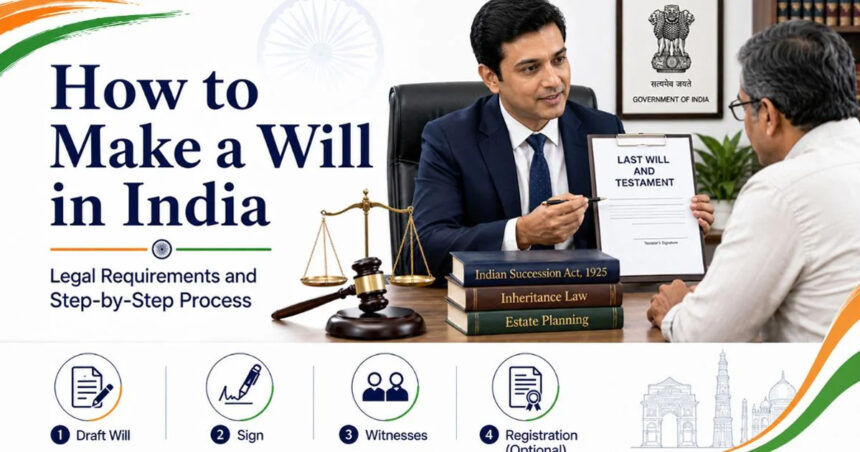
A will decides who receives your property after you die. Without one, the law of succession that applies to you decides. Knowing how to make a valid will in India avoids family disputes and long court cases. This explainer covers who can make a will, how it must be signed and witnessed, whether to register it and when probate is needed.
Key takeaways
- Any adult of sound mind can make a will, under the Indian Succession Act, 1925.
- It must be signed and attested by two witnesses, under Section 63.
- Registration is optional, but it makes the will harder to challenge.
- Probate is compulsory only in some cases, such as certain wills made in, or dealing with property in, Mumbai, Chennai or the former Bengal territories, including Kolkata.
Who can make a will?
Under Section 59 of the Indian Succession Act, 1925, every person of sound mind who is not a minor may make a will. A person who is ordinarily insane can make a will during a lucid interval. A will made under fraud, coercion or undue influence is void.
The Act’s provisions on wills apply to Hindus, Sikhs, Jains, Buddhists, Christians and Parsis, with some differences. Muslims are generally governed by Muslim personal law. Under it, a bequest is usually limited to one-third of the estate, and more needs the heirs’ consent.
How should a will be signed?
Section 63 sets out how an unprivileged will must be executed:
- The testator must sign or put their mark on the will, or have someone sign in their presence and by their direction.
- The signature must show that it was intended to give effect to the document as a will.
- Two or more witnesses must attest the will. Each must have seen the testator sign, or received the testator’s acknowledgement of the signature.
- Each witness must sign in the presence of the testator.
The witnesses do not need to know what the will says. They only confirm the signing.
Witnesses to a will: who should you choose?
Choose two adults who are not beneficiaries. Section 67 says a bequest to an attesting witness, or their spouse, is void, though the will itself remains valid. Witnesses who are younger than you, and easy to contact later, are a sensible choice.
In our view, a doctor’s certificate of sound mind, made at the time of signing, can help if the will is challenged later. It is not required by law, but it is useful evidence.
Will registration: is it compulsory?
No. Under the Registration Act, 1908, registering a will is optional. You can register it at the sub-registrar’s office, with the witnesses present.
Registration does not make a will valid on its own, and an unregistered will is not invalid. But a registered will is kept safely in official records. It is also harder to challenge on grounds such as forgery.
Probate of will: when is it needed?
Probate is a certificate from a court confirming that the will is genuine and appointing the executor. Sections 57 and 213 of the Act make probate compulsory in some cases.
These are wills by Hindus, Buddhists, Sikhs and Jains made within certain areas. The first area is the territories formerly under the Lieutenant-Governor of Bengal, which include Kolkata. The second is the original civil jurisdiction of the Bombay and Madras High Courts. The rule also covers wills dealing with immovable property in those areas.
Outside these cases, probate is usually not compulsory, though banks or registries may ask for it. Ask a lawyer whether your will needs probate.
What should a will include?
- Your full name, address and a declaration that this is your last will, revoking earlier wills.
- A list of your assets, with enough detail to identify them.
- Who receives what, clearly named.
- An executor to carry out the will.
- The date and place, your signature and the witnesses’ signatures and details.
Keep the language simple. Ambiguity is the main cause of disputes over wills.
Can you change or cancel a will?
Yes. A will takes effect only on death, so you can change or revoke it at any time while you are of sound mind. A later will that revokes earlier wills replaces them. Small changes can be made by a codicil, which must be signed and witnessed like a will.
What mistakes cause disputes?
- Only one witness, or witnesses who did not see the signing.
- A beneficiary acting as a witness.
- Unclear descriptions of property or beneficiaries.
- Unsigned changes written on the will after signing.
- Leaving out property acquired after the will was made.
What we don’t know yet
- Nothing here is time-sensitive. The rules on making a will have not changed recently, but personal laws and State practices on registration and probate can vary.
Frequently asked questions
How many witnesses are needed for a will in India?
At least two, under Section 63 of the Indian Succession Act, 1925. Each witness must see the testator sign or receive their acknowledgement, and must sign in the testator’s presence.
Is it compulsory to register a will in India?
No. Registration is optional under the Registration Act, 1908. A registered will is, however, harder to challenge.
When is probate compulsory for a will?
It is compulsory for wills by Hindus, Buddhists, Sikhs and Jains made in certain areas. These are the territories formerly under the Lieutenant-Governor of Bengal, including Kolkata, and the original civil jurisdiction of the Bombay and Madras High Courts. Wills dealing with immovable property there are also covered.
Can a beneficiary be a witness to a will?
They can sign, but under Section 67 the bequest to that witness, or their spouse, becomes void. The rest of the will stays valid.

Mansi Vishal Kale
Manasi V Kale is a law student at MIT-WPU School of Law, Pune, and serves as a Legal Correspondent at My Legal Employer. She contributes articles covering diverse areas of law, recent legal developments, regulatory updates and current affairs. Through her writing, she aims to explore important legal issues and present legal information in a clear, informative and accessible manner for legal professionals, students and readers interested in the evolving legal landscape.