NEW DELHI | 26 NOVEMBER 2026
The Supreme Court has ordered the Food Safety and Standards Authority of India (FSSAI) to add additional visual warning labels to packages for foods that have high levels of fat, sugar and/or salt. It has allowed around four months in which to devise new front-of-pack labelling rules.
The order was passed by a Bench consisting of Justices J.B. Pardiwala and K. Vinod Chandran following a Public Interest Litigation brought by 3S and Our Health Society, relying on Article 32 of the Constitution.
What labels has the Supreme Court ordered?
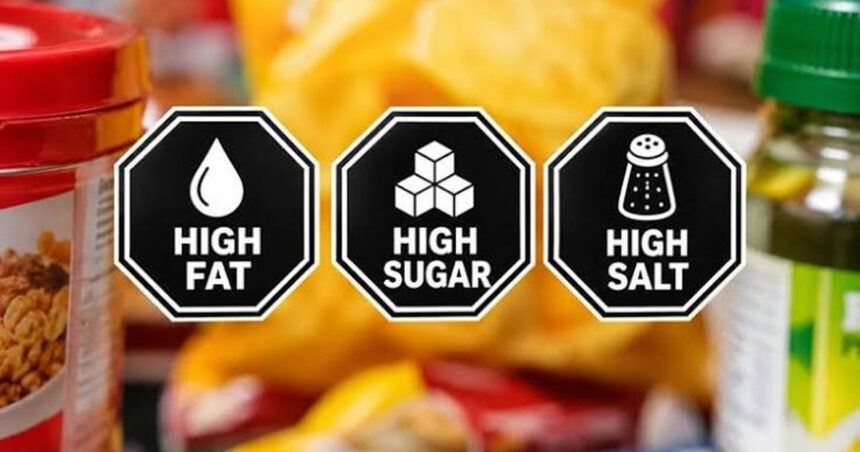
For each of the nutrients that can present a risk to health, the Court has ordered that there should be an individual hexagon shaped warning label.
Products deemed to have high levels of any of these nutrients should be labelled with one of the following warnings:
HIGH FAT
HIGH SUGAR
HIGH SALT
Each warning label should be accompanied by a uniform visual icon that is relevant to the particular nutrient. A multi-nutrient icon will not meet the requirements.
Furthermore, the area of each warning label must cover around 4-5% of the main package display. FSSAI is to also establish what font will ensure the warning is both highly visible and legible.
FSSAI instructed to review nutrient cut-off points
An important element of the judgement relates to the way in which high levels of nutrients are determined.
Whilst FSSAI had previously based its evaluation of high nutrient levels on added sugars and fats, the Court has ordered that it should now also take into account total sugars and saturated fat.
This is relevant as, although these nutrients may not have been specifically added during production, foodstuffs can still contain high levels of either or both.
Hence, in establishing which foods need to be labelled, FSSAI must refer to scientific data.
Four month timescale for new rules
FSSAI advised the Court that it will need around four months to develop new rules.
This is to include; preparing and then seeking feedback on draft rule changes via a 60 day consultation exercise. Feedback will be sought from interested parties both nationally and via the World Trade Organisation. Having analysed such views, final rules will then be published in the Official Gazette.
Whilst emphasising the importance of abiding by this timetable, the Court warned that it should not permit stakeholder consultation to indefinitely postpone commencement of new rules.
Following ten weeks, the case will again be noted so that FSSAI can provide an update and lodge an affidavit explaining the actions it has taken.
Health and right to choose
The judgement incorporates food labelling within the wider context of a citizen’s rights to both health and food together with their right to receive sufficient information in order to make suitable decisions.
It acknowledged that it is essential that nutritional information is clearly presented so that consumers can recognise possible health hazards when shopping.
Moreover, the judgement reflects the duty of the State to safeguard general health by maintaining robust food safety regulation.
Whilst the ultimate labelling rules have not yet been directly applied to all food business operators, once FSSAI has completed the stipulated procedure for developing new rules, an implementation protocol and a period of transition will subsequently come into effect.

Kshitij Naik
Kshitij Naik is a fourth-year B.A. LL.B. student at MIT-WPU School of Law, Pune, with a strong academic record and multiple published research papers to his name. His writing focuses on arbitration, intellectual property, and corporate law. He believes good legal writing should simplify, not complicate, and brings that approach to every article he writes.