
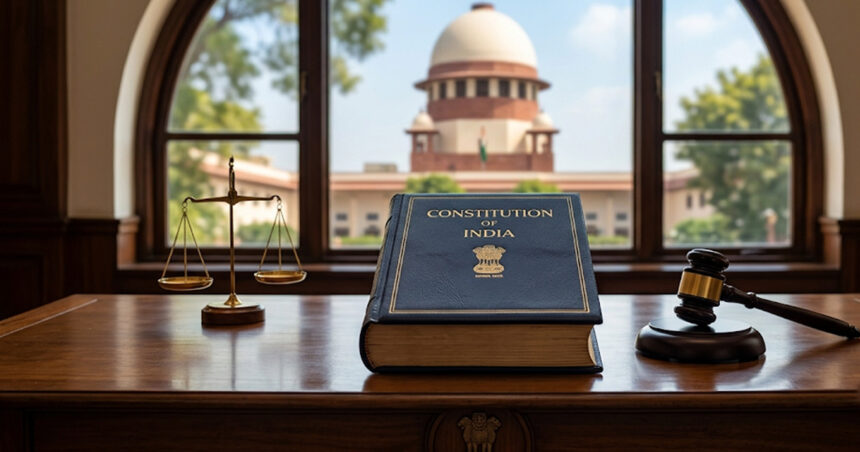
The Basic Structure Doctrine establishes that while Parliament can amend any part of the Constitution, it cannot alter its fundamental identity or core framework. As one of the most consequential principles in Indian Constitutional Law, the doctrine was developed by the Supreme Court despite having no explicit mention in the text of the Constitution. This article traces its origins, evolution, and the ongoing debate over whether it represents constitutional self-preservation or judicial overreach.
- What is the Basic Structure Doctrine?
- Origins of the Debate: Shankari Prasad and Sajjan Singh
- The Golaknath Judgment (1967)
- The Kesavananda Bharati Case (1973)
- Testing the Doctrine During the Emergency
- Evolution Since 1973
- Judicial Independence and Constitutional Accountability
- Current Position of the Doctrine
- Judicial Activism?
-
- Constitutional Self-Protection
- Conclusion
What is the Basic Structure Doctrine?
Article 368 empowers Parliament to amend the Constitution, though the text itself sets no explicit boundaries on how far that power extends. Bridging this gap, the Supreme Court ruled that Parliament’s amending power is not absolute—it cannot destroy the Constitution’s foundational identity. Through this doctrine, Constitutional Supremacy is safeguarded, ensuring that the Constitution remains superior to all state institutions and legislative majorities.
Origins of the Debate: Shankari Prasad and Sajjan Singh
Initially, the Supreme Court adopted a literal, broad view of Parliament’s amending power. In Shankari Prasad Singh Deo v. Union of India (1951), the Court upheld the First Amendment, ruling that constitutional amendments enacted under Article 368 do not constitute “law” within the meaning of Article 13(2). This position was reaffirmed in Sajjan Singh v. State of Rajasthan (1965), which upheld the Seventeenth Amendment. Both rulings confirmed that Parliament could amend Fundamental Rights.
However, signs of judicial unease emerged in Sajjan Singh. In his concurring opinion, Justice J.R. Mudholkar questioned whether altering the basic features of the Constitution amounted to merely amending it or effectively rewriting it, concern that would later anchor the Basic Structure Doctrine.
The Golaknath Judgment (1967)
On 27th February 1967, an 11-judge bench of the Supreme Court reversed its earlier stance by a narrow 6:5 majority in I.C. Golaknath v. State of Punjab. The Court held that constitutional amendments fall within the definition of “law” under Article 13, meaning Parliament could no longer amend Part III (Fundamental Rights) of the Constitution.
This created a constitutional deadlock by restricting Parliament’s ability to enact socio-economic reforms. In response, Parliament passed the 24th Constitutional Amendment Act (1971), inserting Article 13(4) and amending Article 368 to clarify that constitutional amendments were immune from Article 13 challenges. A constitutional balance had to be struck.
The Kesavananda Bharati Case (1973)
That balance was established by a historic 13-judge bench in Kesavananda Bharati v. State of Kerala (1973). By a razor-thin 7:6 majority, the Court overruled Golaknath and restored Parliament’s power to amend any provision of the Constitution, including Fundamental Rights—subject to one crucial limitation: Parliament cannot damage or destroy the Basic Structure of the Constitution.
While upholding the 24th Amendment, the Court struck down the second limb of Article 31C (inserted by the 25th Amendment), which sought to bar judicial review of certain laws. Rather than publishing an exhaustive list of “basic features,” the Court held that the Constitution possesses a distinct identity that cannot be abrogated.
Testing the Doctrine During the Emergency
The real strength of the doctrine became evident during the National Emergency (1975–77), when the executive introduced sweeping amendments to insulate power from judicial scrutiny:
- Indira Nehru Gandhi v. Raj Narain (1975): The Supreme Court struck down Clause (4) of Article 329A—introduced by the 39th Amendment to place the Prime Minister’s election beyond judicial review—holding that it violated democracy and free and fair elections.
- Minerva Mills Ltd. v. Union of India (1980): Parliament had passed the 42nd Amendment, adding Clauses (4) and (5) to Article 368 to grant itself unlimited amending power and bar judicial review of amendments. The Court invalidated both clauses (along with Section 4 of the Amendment, which subordinated Fundamental Rights to all Directive Principles), affirming that a limited amending power is itself a basic feature of the Constitution.
These rulings established a foundational rule: procedural compliance under Article 368 does not validate an amendment if it violates the core spirit of the Constitution.
Evolution Since 1973
Over the decades, the Supreme Court has invoked the doctrine to protect institutional checks and democratic values:
- R. Bommai v. Union of India (1994): A 9-judge bench affirmed that secularism, federalism, democracy, and judicial review of Presidential proclamations under Article 356 form part of the basic structure.
- L. Chandra Kumar v. Union of India (1997): The Court ruled that the power of judicial review vested in the High Courts (Article 226) and the Supreme Court (Article 32) is an inviolable feature of the basic structure.
- I.R. Coelho v. State of Tamil Nadu (2007): A 9-judge bench held that laws inserted into the Ninth Schedule after 24th April 1973 (the date of the Kesavananda judgment) are not immune from judicial review and can be struck down if they violate the basic structure—identifying equality, rule of law, separation of powers, and judicial review as core elements.
Judicial Independence and Constitutional Accountability
One of the doctrine’s most enduring contributions is safeguarding judicial independence. A constitutional democracy relies on institutional checks and balances, and an independent judiciary serves as the citizen’s final line of defense against majoritarian overreach. Without it, federalism, civil liberties, and democratic accountability would remain vulnerable to shifting political pressures.
Current Position of the Doctrine
More than five decades after Kesavananda Bharati, the doctrine continues to shape constitutional interpretation, even when it is not the direct ground for striking down a law. For example, in the Electoral Bonds case (Association for Democratic Reforms v. Union of India, decided on 15th February 2024), a 5-judge bench struck down the anonymous corporate political funding scheme. Because the scheme was introduced through ordinary legislation (the Finance Act, 2017) rather than a constitutional amendment, the Court invalidated it directly under Fundamental Rights—specifically voters’ right to information under Article 19(1)(a) and the right to equality under Article 14—rather than the Basic Structure Doctrine. Nevertheless, the ruling reflects how basic structural values like democratic transparency guide judicial reasoning.
Today, the doctrine serves a dual role: it acts as a substantive limit on constitutional amendments and provides an interpretive compass for constitutional adjudication.
Judicial Activism?
Critics argue that the Basic Structure Doctrine is an exercise in judicial overreach for two main reasons:
- Lack of textual basis: The phrase “basic structure” appears nowhere in the Constitution, leading critics to argue that the judiciary invented a limitation not intended by the Constituent Assembly.
- Subjectivity and democratic legitimacy: Because the Court has never defined a closed list of basic features, unelected judges retain broad discretion to decide what constitutes the Constitution’s “identity”—a concern underscored by the narrow 7:6 split in Kesavananda Bharati.
Constitutional Self-Protection
Proponents counter that the doctrine is essential for constitutional self-preservation. If Parliament possessed unlimited amending power, a transient parliamentary majority could abolish judicial review, dismantle federalism, or suspend civil liberties altogether—scenarios directly confronted in Raj Narain and Minerva Mills. The doctrine does not elevate the judiciary above Parliament; rather, it preserves the foundational framework from which both Parliament and the judiciary derive their authority.
Conclusion
The Basic Structure Doctrine reconciles the need for constitutional adaptability with the imperative of constitutional continuity. It allows the Constitution to evolve with changing times while ensuring its core democratic promises remain intact. Whether viewed as judicial creativity or a constitutional necessity, its role in preserving Indian democracy is undeniable. While constitutional amendment is vital for progress, safeguarding constitutional identity remains indispensable and reading the original judgments offers the clearest window into how that balance was forged.
-Adv. Vishal Kale