
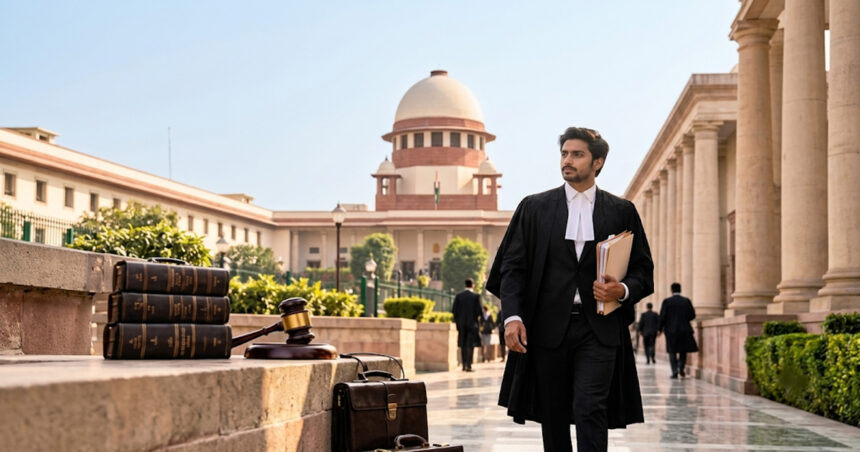
Most judges in India’s district courts start as a Civil Judge (Junior Division). They are selected through a competitive exam held by each State’s High Court or Public Service Commission.
- What are the two routes into the judiciary?
- What does a civil judge do?
- Who can become a civil judge?
- Civil judge exam: what are the three stages?
- What is the PCS J exam pattern?
- Judiciary exam syllabus: which subjects matter most?
- Judiciary preparation strategy: how should you prepare?
- How do you answer mains questions?
- How do you prepare for the judiciary interview?
- A 12-month preparation timeline
- What mistakes do judiciary aspirants make?
- What happens after you are selected?
- Frequently asked questions
This guide explains how to become a judge in India. It covers who is eligible after the Supreme Court’s 2026 ruling, how the exam works, what to study and how to prepare. Exam rules vary by State, so always read the notification you are applying under.
Key takeaways
- The entry post: Civil Judge (Junior Division), also called Judicial Magistrate First Class in some States.
- Eligibility now: fresh law graduates can sit exams notified up to 31 March 2027. After that, one year of verified practice is needed.
- Three stages: a preliminary exam (objective), a main exam (written) and an interview (viva voce).
- After selection: two years of training, at the State Judicial Academy and as a law clerk, before regular appointment.
What are the two routes into the judiciary?
Civil Judge (Junior Division). The main entry route for law graduates and young advocates. This guide focuses on it.
Higher Judicial Service (District Judge). Experienced advocates can enter directly as District Judges through a separate exam. Under Article 233 of the Constitution, an advocate needs at least seven years of practice to be appointed a District Judge.
What does a civil judge do?
A Civil Judge (Junior Division) hears civil suits up to a certain value. In many States, the same officer also sits as a Judicial Magistrate First Class in criminal cases. The work involves recording evidence, hearing arguments, writing judgments and orders, and managing a heavy daily list of cases. Over time, civil judges are promoted to Civil Judge (Senior Division) and, later, to the Higher Judicial Service as District Judges.
Who can become a civil judge?
You need:
- an LLB degree recognised by the Bar Council of India;
- to meet the age limit in the State’s rules. For example, the Delhi Judicial Service Rules set an upper age of 32, while Maharashtra’s 2026 advertisement set 21 to 35 for most candidates, with relaxation for some categories;
- any language requirement, such as knowledge of the State’s official language;
- the practice requirement, as it currently stands.
The practice rule after Bhumika Trust. In Bhumika Trust v. Union of India (21 August 2026), the Supreme Court allowed law graduates to apply without practice for exams notified up to 31 March 2027. From 1 April 2027, candidates will need at least one year of verified practice in the district courts. Our civil judge eligibility explainer covers the details.
Civil judge exam: what are the three stages?
Stage 1: Preliminary exam
An objective, multiple-choice screening test. It usually covers the main civil and criminal laws, the Constitution, and sometimes general knowledge and language. Marks are often used only to shortlist candidates for the main exam.
Example (Delhi): one paper of 200 marks with 25% negative marking. You need 60% to qualify (55% for reserved categories), and these marks are not counted in the final merit.
Stage 2: Main exam
Descriptive written papers that test your knowledge of the law and your ability to write judgments, frame issues and translate. Example (Delhi): four papers totalling 850 marks: General Legal Knowledge and Language (250), Civil Law I (200), Civil Law II (200) and Criminal Law (200).
Stage 3: Interview (viva voce)
A panel, usually of High Court judges, assesses your legal knowledge, judgment and personality. Example (Delhi): 150 marks, with final merit based on the main exam and the interview together.
What is the PCS J exam pattern?
“PCS (J)” is the name commonly used for the judicial service exams conducted by Public Service Commissions in States such as Uttar Pradesh. The broad structure of preliminary, main and interview is common across States. But the number of papers, the marks, negative marking and the language papers differ. Read the scheme in your State’s notification before you plan.
Judiciary exam syllabus: which subjects matter most?
Most State syllabi cover:
- Procedure: the Code of Civil Procedure, 1908; the Bharatiya Nagarik Suraksha Sanhita, 2023 (and the Code of Criminal Procedure for older cases); and the Bharatiya Sakshya Adhiniyam, 2023 (and the Indian Evidence Act).
- Substantive criminal law: the Bharatiya Nyaya Sanhita, 2023 (and the Indian Penal Code).
- Civil laws: contract, specific relief, transfer of property, limitation and family laws.
- The Constitution of India.
- Local laws of the State, such as rent control or land revenue laws.
- Language: essay, translation and précis, often in English and the State’s language.
Many questions still refer to both the old and the new criminal laws. Learn both sets of section numbers from the Bare Acts on India Code.
Judiciary preparation strategy: how should you prepare?
These are our suggestions:
- Start with the Bare Acts. Judiciary exams test the text of the law. Read the CPC, BNSS, BSA and BNS section by section.
- Use previous papers. High Courts and Public Service Commissions publish past papers. They show you how questions are framed.
- Practise writing. Write one answer, one judgment or one framing of issues every day, and time yourself.
- Learn your State’s local laws early. They are often neglected and can decide your rank.
- Prepare for the interview throughout. Read judgments and follow legal news, so that you can discuss current issues calmly.
- Revise in cycles. Go back over your notes every few weeks rather than reading once.
How do you answer mains questions?
The main exam rewards clear structure as much as knowledge. These are the formats you should practise.
Framing issues. Read a set of pleadings and frame the issues for trial, as a judge would. Each issue should be a single question that can be answered yes or no, with the burden of proof on the right party.
Judgment writing. A judgment usually covers the facts, the issues, the evidence on each issue, findings with reasons, and the final order. Practise writing one civil and one criminal judgment every week, in the time your State’s exam allows.
Law answers. Start with the provision, explain its ingredients, apply them to the facts, and cite one or two leading judgments. Write the new criminal law section first, with the old one in brackets.
Translation and essay. Many States test translation into and out of the State’s language, and an essay. Practise these regularly; they are easy marks to lose.
How do you prepare for the judiciary interview?
The interview panel looks for legal knowledge, balance and temperament. Expect questions on your State’s local laws, recent Supreme Court and High Court judgments, and why you want to be a judge.
These are our suggestions:
- Know your form. Panels often ask about your college, your home district and anything you list as a hobby.
- Follow recent judgments. Know two or three important rulings well enough to explain them simply.
- Think before you answer. A calm “I am not certain, but I would look at Section X” is better than a confident wrong answer.
- Practise aloud. Mock interviews with friends or teachers help you speak clearly under pressure.
A 12-month preparation timeline
This timeline is our suggestion. Adjust it to when your State’s notification is expected.
- Months 1 to 3: read the Bare Acts of the CPC, BNSS, BSA and BNS, and the Constitution, section by section.
- Months 4 to 6: add civil laws (contract, specific relief, transfer of property, limitation) and your State’s local laws. Start writing one answer a day.
- Months 7 to 9: solve previous prelims papers and write full mains papers under time limits. Practise judgment writing and framing issues weekly.
- Months 10 to 12: revise in cycles, take full mock tests, and start interview preparation alongside.
What mistakes do judiciary aspirants make?
- Reading commentaries before the Bare Act itself.
- Ignoring local laws until the last month.
- Practising multiple-choice questions only, and not writing answers.
- Studying for one State’s pattern and then applying to another without adjusting.
What happens after you are selected?
Under the Supreme Court’s 2026 ruling, selected candidates are appointed as Trainee Judicial Officers. They spend one year at the State Judicial Academy and one year as a law clerk. The clerkship is split between a district-level judge and a sitting High Court judge, six months each.
During these two years they receive half the pay of a Judicial Magistrate First Class. Regular appointment follows a satisfactory evaluation.
Frequently asked questions
How can I become a judge after LLB in India?
Clear your State’s Civil Judge (Junior Division) exam, which has preliminary, main and interview stages. For exams notified up to 31 March 2027, fresh law graduates can apply without practice. After that, one year of verified practice will be needed.
What is the age limit for the civil judge exam?
It varies by State. For example, the Delhi Judicial Service Rules set an upper age of 32, while Maharashtra’s 2026 advertisement set 21 to 35 for most candidates. Check the notification for your State.
What subjects are in the judiciary exam syllabus?
Usually the CPC, criminal procedure (BNSS and CrPC), evidence (BSA and the Evidence Act), criminal law (BNS and IPC) and the Constitution. Most States also test civil laws such as contract and property, their own local laws, and language.
How long does it take to prepare for the judiciary exam?
It depends on your foundation. Many candidates prepare for a year or more. Starting with the Bare Acts during law school shortens the process.
Can I become a District Judge directly?
Yes, as an advocate with at least seven years of practice, under Article 233 of the Constitution. Advocates enter through the Higher Judicial Service exam, which is separate from the civil judge exam.