



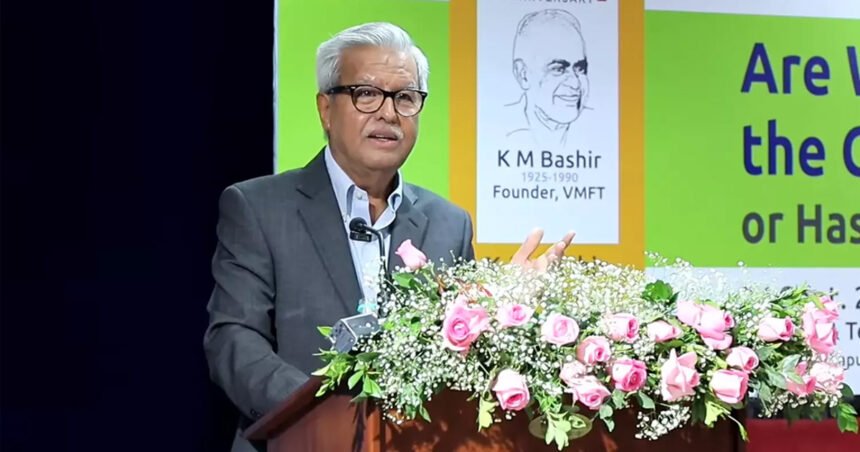
Senior Advocate Dushyant Dave, addressing the 17th K.M. Bashir Memorial Lecture “Are We Failing the Constitution or Has the Constitution Failed Us?” has, once again, laid bare the failings of the Indian judiciary. Having practiced for 48 years, and seen some exceptional judges, while an equal, if not greater number of corrupt ones, Dave stated that the very foundation of one of our most basic human requirements, namely, justice, has been damaged beyond repair. The speech is a damning indictment of the Indian judiciary and highlights the flaws in various judicially mandated systems, from the internal disciplinary machinery to the process of appointment and selection.
What Dave actually said
In his speech, Dave stated that the system favored the rich and influential as their petitions “move faster” and rarely fail. He cited the numerous instances where major industrial houses seem to secure favorable orders from the courts. He went on to say that while the government and the judiciary had traditionally enjoyed a close relationship, the judiciary has grown uncharacteristically hesitant in invoking its power under Article 32 to safeguard the justiciable rights of Indian citizens, even in the face of demonstrable evidence of such violations. However, Dave was keen to point out that such an apathy was not necessarily restricted to the post-2014 period, or even the tenure of the Indira Gandhi-led Emergency; rather, the judiciary has, over time, shown signs of such institutional hesitation.
Regarding the composition of the judiciary, Dave criticized Chief Justice D.Y. Chandrachud for his seventeen-year-long tenure as head of the judiciary, which did not see the appointment of a single woman to the Supreme Court. While the judiciary, with its overwhelming representation of the privileged castes and the legal fraternity, can understand disputes in terms of “law,” it fails to grapple with the socio-cultural realities of the litigants, thus necessitating greater diversity in its composition.
Dave was further critical of the press which, he said, had failed the people of this country. He accused the television media of creating an uncritical, feel-good narrative around the country’s success while shying away from asking hard questions, particularly of the Prime Minister, whom he claimed had not granted a single press conference since 2014.
Why this matters beyond a single speech
Adv. Dave is a former President of the Supreme Court Bar Association and one of the most senior practicing advocates in the country. Given his vast experience of the system, it is worth considering what he meant when he said that corruption in the system had become impossible to count.
India’s primary method for dealing with errant judges is impeachment under the Constitution, and the detailed procedural law that deals with the investigation of such charges. In practice, however, this approach has rarely, if ever, been used to actually remove a judge from office, mainly due to the complex and unwieldy procedure which requires a special majority in Parliament. Apart from impeachment, there is no other independent mechanism for investigating and punishing norm-violating behavior by judges the way an anti-corruption ombudsman might.
The system of appointments is equally lacking in transparency and is governed by a largely undisciplined collegium system, which does not permit much in the way of external evaluation of the selection criteria. In fact, this is what Dave was referring to when he criticized the all-male appointments under a particular Chief Justice.
Other democracies have tackled this issue in various ways which, while far from perfect, have created more transparency in the selection and removal processes. Most common law countries, which have a largely similar set of traditions concerning the judiciary, have laws that require a judge to be removed only after a formal complaint has been investigated by a formal complaints authority. Furthermore, many such jurisdictions have a concept of “judicial tenure during good behavior” which allows removal for serious misconduct without having to go through the onerous process of impeachment. Many newer democracies have taken this one step further by creating judicial appointment commissions which are legally bound to consider diversity issues in addition to merit while recommending names for appointment.
The common thread that binds many of these solutions is the existence of a visible and publicly accessible process for registering complaints, investigating them, and, where appropriate, taking disciplinary action. It is not that such countries are immune from charges of judicial corruption, but that the people of such countries do not have to wait for a senior-level lecture before such allegations can be formally investigated.
Where reform could realistically begin
An independent complaints authority to investigate and take disciplinary action, short of the very onerous process of impeachment, could be a great place to begin. It would create teeth to the otherwise toothless system of internal judiciary investigations and reprimands. Such a body need not necessarily undermine judicial independence; rather, it would merely differentiate between judicial independence and who gets to judge whether a judge has behaved inappropriately, something that the existing collegium system does not allow.
A publicly accessible code of conduct for judges, with appropriate punitive measures for transgressions, ranging from a mere private censure to recommendation for removal from office, would also go a long way. Currently, there is no easily accessible code of conduct for judges which lays down punishments for unethical but non-criminal behavior.
Finally, collegium decisions regarding appointments could be published, at the very least, in summary form, with reasons, after the fact. Such a move would not necessarily fix the problems of diversity that Dave pointed out, but would demonstrate a willingness to allow greater public scrutiny of the judiciary. This would allow the bar associations, civil society, and researchers to follow trends regarding the composition of the judiciary, similar to the way that Dave highlighted the lack of women’s representation under a particular Chief Justice Diversity needs to be considered as a stated criterion when considering appointments and not an afterthought. Both gender and diversity quotas need to be seriously considered if the judiciary is to continue to function as a body that can understand and adjudicate a wide variety of disputes. Finally, the very existence of the ability of the Supreme Court to cite Article 32 in cases where fundamental rights have been violated must be questioned if the Court is truly willing to use such a tool as a safeguard for the rights of Indian citizens.
The bigger picture
The judiciary’s independence from external forces is meant to grant it the flexibility of thought to make decisions that are fair to all sides. However, the same independence, when divorced from any accountability, can all too easily lead to a situation where the judiciary holds itself up as the final arbiter of all disputes but does not feel the need to answer to any higher authority. Such a situation has the potential to encourage corruption, misbehavior, and nepotism and when senior members of the bar call such behavior to account, it must be investigated and dealt with, rather than dismissed as impossible to count.
Dave’s lecture will not end the debate, but it does raise a pertinent question which the Indian judiciary must answer: if impeachment is not the answer, then what? It is this question which must become a feature of our judiciary for it to continue to retain the faith of the people. For law students, it is important to follow such debates since understanding the intricacies of impeachment, collegium decisions, diversity in the judiciary, and the issues of accountability are what it means to be a serious student of law.