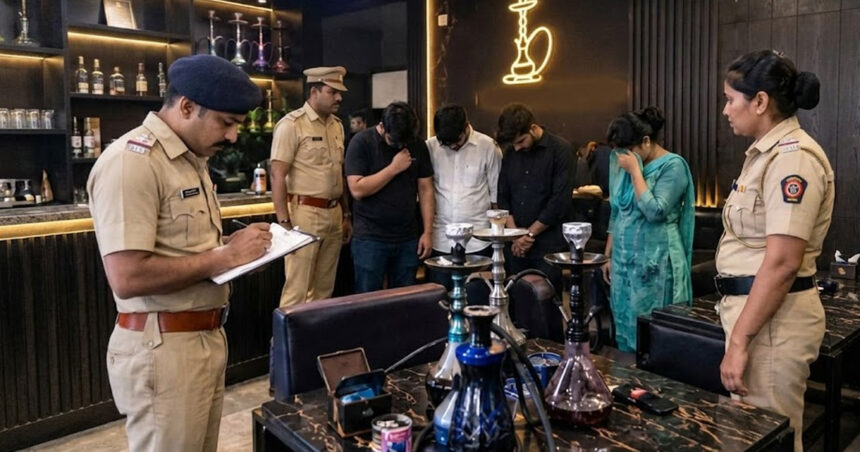
A Pune sessions court has granted bail to four people accused in the Swargate hookah case, holding that “nothing is required to be recovered and discovered from the accused”. In separate orders dated 21 October 2026, Additional Sessions Judge U.P. Kulkarni granted anticipatory bail to a hotel’s alleged owner, manager and partner, and regular bail to a waiter arrested on 7 October.
Key points
• Three accused received anticipatory bail and one received regular bail.
• Custodial interrogation was held unnecessary because all the hookah equipment and tobacco had been seized.
• The accused must report to Swargate police station every Monday until the chargesheet is filed.
The case
According to the prosecution, police raided a hotel in the Swargate area at about 3:45 pm on 7 October 2026 and allegedly found a waiter serving hookah tobacco to customers. They seized seven glass hookah pots, six pipes, five chillums and a tin of flavoured tobacco, Punekar News reported.
The waiter allegedly named the other three as the hotel’s owner, manager and partner. The case was registered under Sections 123 and 3(5) of the Bharatiya Nyaya Sanhita, 2023 (BNS) and Sections 4A and 21A of the Cigarettes and Other Tobacco Products Act, 2003 (COTPA), as amended in Maharashtra. We have not named the accused, since none has been convicted.
The arguments
The defence argued that the accused had been falsely implicated, that Section 123 BNS did not apply, and that the three applicants for anticipatory bail were not placed at the raid. The prosecution opposed bail, citing the seriousness of the allegations, an incomplete investigation and the need to examine call detail records.
Why the waiter’s statement matters less than it seems
The case against the three applicants rests largely on what the waiter allegedly told the police. Statements made to the police during investigation generally cannot be used as evidence at trial, except to contradict a witness (Section 181 of the Bharatiya Nagarik Suraksha Sanhita, 2023, formerly Section 162 CrPC).
A confession to a police officer is inadmissible under Section 23 of the Bharatiya Sakshya Adhiniyam, 2023 (formerly Section 25 of the Evidence Act). In our view, this helps explain why the Court was not persuaded that custody was needed.
The Court’s reasoning
The judge held that a detailed appraisal of evidence was not appropriate at the bail stage. Since the equipment had been seized, custodial interrogation was unnecessary. Three of the accused had no criminal antecedents, and the Court held that the fourth accused’s earlier cases alone did not justify refusing bail.
As reported, the judge also referred to the Bombay High Court’s order in Omkar Ram Jivan Gupta v. State of Maharashtra (Anticipatory Bail Application No. 2551/2023, decided on 24 November 2025). That order granted anticipatory bail while noting that whether Section 328 IPC applies to similar cases was pending before the Supreme Court.
Section 328 IPC has been replaced by Section 123 BNS.
Bail conditions
Each accused must furnish a personal bond of ₹25,000 with one surety, report to Swargate police station every Monday between 11 am and 2 pm, not influence witnesses, and not commit similar offences.
The law in brief
Section 123 BNS (formerly Section 328 IPC) punishes administering a poisonous, stupefying or unwholesome substance with intent to cause hurt or to commit an offence. Whether serving flavoured hookah tobacco falls within it is contested. Maharashtra separately banned hookah bars through a 2018 amendment to COTPA. Anticipatory bail is governed by Section 482 of the BNSS (formerly Section 438 CrPC).
These are bail orders. They do not finally decide whether Section 123 applies to hookah cases.
For law students: bail in practice
Bail hearings in sessions courts are where many criminal law interns start. This order shows the factors courts weigh: what remains to be recovered, antecedents, the stage of investigation and the risk of tampering. The same necessity test runs through this week’s Bombay High Court ruling on illegal arrest.
What to do now
• 1st–2nd year : Read Sections 480 to 483 of the BNSS on bail and anticipatory bail.
• 3rd–4th year : Draft a mock anticipatory bail application on these facts. Our internship roadmap explains how to find a criminal law placement.
What we don’t know yet
• When the police will file a chargesheet.
• How the Supreme Court will decide the pending question on Section 328 IPC in hookah cases.
Frequently asked questions
Why did the Pune court grant bail in the Swargate hookah case?
Because all the equipment and tobacco had been seized, nothing remained to be recovered, and custodial interrogation was not needed. The Court also noted that three accused had no criminal antecedents.
Is a hookah bar illegal in Maharashtra?
Maharashtra banned hookah bars through a 2018 amendment to COTPA, which added Sections 4A and 21A as they apply in the State.
Does the bail order mean the accused are innocent?
No. Bail is not an acquittal. The case remains under investigation.
This article is general information, not legal advice.

Adv. Manjot Kathawade
Manjot P. Kathawade is an advocate practising in Pune, with a background in law and international business. His interests span corporate law, competition law, banking law, and legal strategy. He believes good legal writing should simplify, not complicate, and brings a practical, business-oriented perspective to every article he writes.