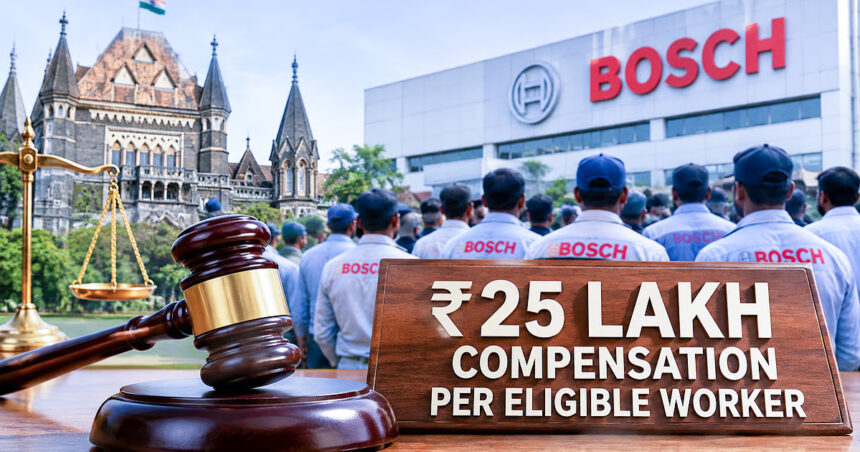
Court modifies Nashik Industrial Court’s reinstatement order in dispute involving 521 temporary workers transferred from the Nashik plant
MUMBAI | 25 November 2026
Bombay High Court orders Bosch Limited to pay Rs 25 lakh in compensation to grievant workers involved in a manpower transfer case against it related to its Nashik unit.
In question are 521 New Entrant Temporary Workmen (NETW) who were transferred out of the company’s Nashik unit to various places in India on September 7, 2024.
Why was there a case?
Grievants had approached the Nashik Industrial Court and contested the company’s manpower transfers. The Industrial Court cancelled the company’s manpower transfer orders and ordered the company to permit the grievants to be re-employed at the Nashik unit on September 29, 2026.
This order was then appealed by Bosch to the Bombay High Court.
At issue was whether the manpower transfers had been made in good faith or were in fact a method adopted by the company to discharge excess manpower without adhering to the statutory process for downsizing.
What did the Bombay High Court decide?
Whilst agreeing with the Industrial Court that there had been an act of unfair labour practice, the Bombay High Court decided to alter the relief given to the grievants.
Rather than ordering the company to re-employ the grievants at its Nashik unit, the Bombay High Court ordered the company to pay each complainant Rs 25 lakh in compensation.
Payment is to be made within 6 weeks. Should payment not have been made within this time, interest at the rate of 8% per annum will be payable on the compensation due.
Furthermore, the Court noted that those grievants who accepted compensation would not be able to claim additional benefits, either monetary or otherwise, from the company.
What is significant about this decision?
It highlights both the extent of an employer’s transfer powers and the ramifications of employing transfers as an alternative to the statutory downsizing process.
It also shows that whilst the High Court can vary the nature of relief offered by an Industrial Court, it can still agree that there has been an act of unfair labour practice.
This judgement was given on November 19, 2026 and reported on November 25, 2026.

Kshitij Naik
Kshitij Naik is a fourth-year B.A. LL.B. student at MIT-WPU School of Law, Pune, with a strong academic record and multiple published research papers to his name. His writing focuses on arbitration, intellectual property, and corporate law. He believes good legal writing should simplify, not complicate, and brings that approach to every article he writes.